Is Autophagy the Key to Longevity?
Is Autophagy the Key to Longevity?
TL;DR: Autophagy is a real and important cellular repair process that declines with age, but it is not a simple switch or a single key to longevity. Evidence supports its role in healthy aging, but maximising autophagy at all times is neither practical nor desirable — balance with muscle preservation, nutrition, and overall lifestyle matters more.
Autophagy is a genuine and well-studied biological process, but it is not the singular key to longevity. Research consistently shows that autophagy plays a meaningful role in cellular health and healthy aging — yet it is one mechanism among many, and the relationship between autophagy and human lifespan is more nuanced than popular coverage suggests. Understanding what autophagy actually does, how it interacts with fasting, exercise, and nutrition, and where the evidence is genuinely strong versus speculative is far more useful than chasing maximum autophagic activity.
What Is Autophagy and Why Does It Matter for Aging?
Autophagy in Plain English
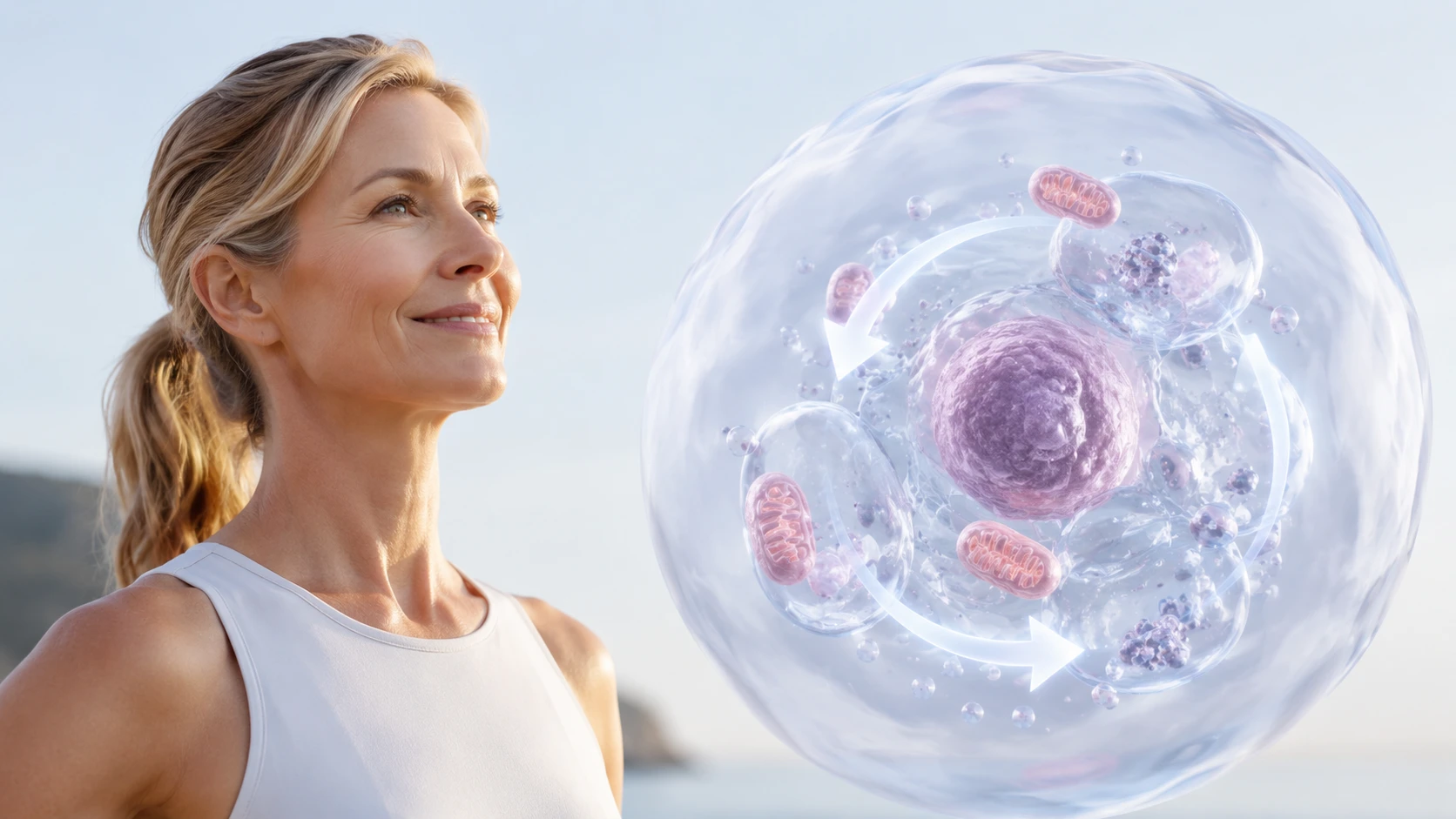
Autophagy — from the Greek for “self-eating” — is the process by which cells identify, break down, and recycle damaged or dysfunctional components. This includes misfolded proteins, worn-out organelles, and cellular debris that would otherwise accumulate and impair function. Think of it as the cell’s internal quality-control and recycling system.
This process is not a switch that flips on or off. Autophagy operates continuously at a baseline level, and its activity increases in response to specific signals — particularly nutrient deprivation, cellular stress, and exercise. It is a normal, conserved biological function present across virtually all living organisms.
Why It Becomes More Important with Age
Autophagic efficiency declines with age. As this happens, damaged proteins and dysfunctional mitochondria accumulate within cells, contributing to the kind of cellular dysfunction associated with age-related diseases. Reduced autophagy has been linked to neurodegeneration (including Alzheimer’s and Parkinson’s disease), cardiovascular decline, metabolic dysfunction, and increased inflammation — all central features of biological aging.
This is why autophagy is a legitimate area of longevity research. Maintaining or partially restoring autophagic activity as we age may support cellular resilience, reduce chronic inflammation, and help preserve tissue function. However, the jump from “autophagy declines with age” to “maximising autophagy extends human lifespan” is not supported by current evidence.
Learn more in our complete guide to longevity.
How Autophagy Works at the Cellular Level
The Key Regulators: AMPK and mTOR
Autophagy is primarily regulated through two nutrient-sensing pathways: AMPK and mTOR.
mTOR (mechanistic target of rapamycin) is the primary brake on autophagy. When nutrients — particularly amino acids and glucose — are abundant, mTOR is highly active and suppresses autophagic activity. This makes biological sense: when energy is plentiful, the cell prioritises growth and protein synthesis over cleanup.
AMPK acts in the opposite direction. When cellular energy is low — during fasting, caloric restriction, or intense exercise — AMPK is activated. This both directly stimulates autophagy and inhibits mTOR, shifting the cell’s priorities from growth toward maintenance and repair.
This push-pull between mTOR and AMPK is central to understanding why fasting and exercise influence autophagy, and also why chronically suppressing mTOR through drugs or extreme restriction carries real risks alongside potential benefits.
Autophagy Is Not Simply “On” or “Off”
A common oversimplification is treating autophagy as a binary state. In reality, autophagic flux — the rate at which cellular material is turned over — exists on a spectrum and varies by tissue, age, metabolic state, and the duration and intensity of any triggering stimulus. The brain, liver, heart, and skeletal muscle each have different autophagic dynamics and different relationships with aging.
Fasting, Exercise, and Autophagy: What the Evidence Shows
Fasting and Autophagy
Fasting is the most studied autophagy trigger. When caloric intake drops, mTOR activity falls and AMPK rises, signalling the cell to upregulate cleanup and recycling. This has been demonstrated reliably in animal models and in human cell and tissue studies.
The practical question — how long does fasting need to be to meaningfully increase autophagy in humans? — is harder to answer with precision. Current evidence suggests that autophagic activity begins to increase after roughly 12–16 hours of fasting, with more sustained increases seen with longer fasts. However, exact thresholds vary between individuals and tissues, and direct measurement of autophagy in living humans remains technically challenging.
Popular fasting protocols such as 16:8 intermittent fasting likely produce modest autophagic upregulation in most people. 24-hour fasting may produce a stronger response. But more fasting is not automatically better — extended fasting without adequate nutrition increases the risk of muscle loss, particularly in older adults, and can impair recovery and immune function.
Exercise and Autophagy
Exercise — particularly endurance exercise and high-intensity training — activates autophagy independently of fasting. The metabolic stress of exercise raises AMPK, temporarily lowers mTOR activity, and has been shown to stimulate autophagic flux in skeletal muscle, cardiac tissue, and the brain in animal studies. Human evidence, while more limited, supports the same directional effect.
Importantly, exercise stimulates autophagy while simultaneously providing benefits that fasting alone cannot — including preserving and building muscle mass, improving cardiovascular function, increasing VO2 max, and supporting metabolic health. This makes exercise a particularly valuable autophagy trigger from a longevity standpoint, since it avoids the muscle-loss trade-off associated with prolonged fasting. Research on whether exercise activates autophagy supports this view.
The Autophagy–Muscle Trade-Off
Why This Balance Matters for Longevity
One of the most important and underappreciated tensions in autophagy-focused longevity strategies is the conflict between cellular cleanup and muscle preservation.
Muscle mass is a strong predictor of healthspan and longevity. Loss of muscle (sarcopenia) accelerates with age and is associated with frailty, metabolic dysfunction, falls, and earlier mortality. Maintaining muscle into older age requires adequate protein intake and resistance exercise — both of which activate mTOR, the primary suppressor of autophagy.
This creates a genuine trade-off. Strategies that aggressively promote autophagy — very long fasting periods, severe caloric restriction, or chronic mTOR suppression — may undermine muscle preservation, particularly in older adults or those already at risk of sarcopenia. The idea that maximising autophagy at all times is desirable does not hold up under scrutiny when muscle health is factored in.
A More Balanced View
Current evidence supports a cyclical approach: periods of moderate fasting or caloric restriction to allow autophagic cleanup, balanced with adequate protein intake and resistance training to preserve muscle. Neither chronic fasting nor chronic mTOR activation appears optimal. The goal is appropriate cycling between anabolic (growth and repair) and catabolic (cleanup and recycling) states, not permanent suppression of either. This is explored further in our article on how to balance autophagy and muscle growth.
Protein intake, often framed as “blocking autophagy,” deserves more nuance. Adequate protein activates mTOR and temporarily reduces autophagic signalling — but it also prevents the muscle loss that would otherwise undermine long-term health. Restricting protein to maximise autophagy is not a sound longevity strategy, especially past middle age.
Supplements and Autophagy: Lower-Confidence Options
Several compounds have been studied for their potential to activate autophagy or related pathways. These include spermidine, fisetin, resveratrol, berberine, and NAD+ precursors. Some of these have shown promising results in cell culture and animal studies. Human evidence, however, is generally limited, short-term, or indirect.
Spermidine, found naturally in wheat germ, mushrooms, and aged cheese, has perhaps the most interesting human data, with some observational evidence linking dietary intake to reduced mortality risk. Fisetin and resveratrol show mechanistic activity in laboratory settings, but robust human trials demonstrating autophagy induction or lifespan extension are lacking. Berberine activates AMPK and has meaningful human evidence for metabolic benefits, though direct autophagy data in humans is limited.
These supplements should be understood as lower-confidence, mechanistic options — potentially complementary to a strong lifestyle foundation, but not substitutes for fasting, exercise, sleep, and nutrition. They are not core longevity interventions with proven human lifespan data.

Expert Opinions and Scientific Evidence
The scientific consensus supports autophagy as a meaningful component of healthy aging biology. Research in model organisms — including yeast, worms, flies, and mice — consistently shows that enhancing autophagic activity extends lifespan. Yoshinori Ohsumi’s 2016 Nobel Prize in Physiology or Medicine recognised the fundamental importance of autophagy mechanisms, lending significant scientific credibility to the field.
In humans, the picture is more cautious. Autophagy is strongly associated with reduced risk of neurodegenerative disease, cardiovascular disease, and cancer in epidemiological and mechanistic research. But directly proving that increasing autophagy extends human lifespan remains beyond current research capabilities. Most human evidence is at the level of biomarkers, cell studies, and short-term intervention trials — not long-term lifespan outcomes.
Experts in aging biology generally position autophagy as an important but overhyped pathway. It is one of several interlocking mechanisms — alongside inflammation, mitochondrial function, cellular senescence, telomere biology, and metabolic health — that together determine how well we age. No single pathway is the key to longevity.
The mTOR Question
The drug rapamycin, which inhibits mTOR and thereby activates autophagy, is one of the most consistently lifespan-extending interventions in animal models. This has generated significant interest in chronic mTOR inhibition as an anti-aging strategy. However, mTOR suppression also impairs immune function, wound healing, and muscle protein synthesis — effects that are acceptable in a laboratory mouse but carry meaningful risks in humans. The difference between transiently lowering mTOR through fasting or exercise and chronically suppressing it through pharmacological means is important, and the two should not be conflated.
References and Resources
Authoritative Sources
-
National Institute on Aging: Autophagy and Aging
nia.nih.govAn accessible overview of how autophagy relates to aging and age-related disease, from a leading US government research body.
-
Trends in Cell Biology: Autophagy and Lifespan Extension
cell.comA peer-reviewed review of the evidence linking autophagic activity to lifespan extension across model organisms and the implications for human aging.
-
PubMed Central: Autophagy in Ageing and Disease
ncbi.nlm.nih.govA scholarly article examining autophagic mechanisms in the context of aging biology and disease pathology.
-
Science Daily: Boosting Autophagy for Better Health
sciencedaily.comA summary of research findings on lifestyle interventions — including fasting and exercise — that upregulate autophagy.
-
Journal of the American Heart Association: Autophagy and Cardiovascular Aging
ahajournals.orgResearch examining the role of autophagy in maintaining cardiovascular function during aging and its implications for heart disease prevention.
-
Frontiers in Cell and Developmental Biology: Autophagy Pathways and Aging
frontiersin.orgA detailed review of autophagic signalling pathways and their molecular connections to the aging process.
-
Nature Scientific Reports: Enhancing Autophagy for Healthy Aging
nature.comResearch on both pharmacological and lifestyle-based approaches to autophagy induction and their potential relevance to longevity.
Frequently Asked Questions
Is autophagy the only factor determining longevity?
No. Longevity is shaped by multiple interacting factors including genetics, inflammation, mitochondrial function, cardiovascular health, muscle mass, metabolic health, sleep, and environment. Autophagy is a meaningful contributor to healthy aging, but it operates alongside these other pathways rather than above them. A holistic approach to lifestyle and health is more likely to support longevity than targeting autophagy alone.
Can autophagy be activated safely at any age?
Moderate autophagy activation through exercise, intermittent fasting, and a balanced diet is generally safe for healthy adults across age groups. Older adults should be more cautious with extended fasting, as the risk of muscle loss increases with age. Anyone with underlying health conditions should consult a healthcare professional before making significant dietary changes.
What are the most effective ways to increase autophagy naturally?
The best-supported methods are regular exercise — particularly aerobic and resistance training — and time-restricted eating or intermittent fasting. Both activate AMPK and transiently reduce mTOR activity, stimulating autophagic flux. A diet that avoids chronic overeating and minimises ultra-processed food also supports the metabolic environment in which autophagy functions well.
Is the link between autophagy and longevity supported by evidence?
The evidence is strong in animal models, where enhanced autophagy consistently correlates with extended lifespan. In humans, autophagy is associated with reduced risk of neurodegeneration, cardiovascular disease, and metabolic disorders — but direct evidence that increasing autophagy extends human lifespan is not yet available. Current human evidence is primarily mechanistic and biomarker-based rather than outcome-based.
Does promoting autophagy carry any risks?
Yes, in certain contexts. Excessive or prolonged autophagy stimulation — particularly through extended fasting or aggressive caloric restriction — can contribute to muscle loss, impair immune function, and compromise recovery. This is particularly relevant for older adults or those with low muscle mass. Balance between autophagic activity and anabolic processes (growth and repair) is important for long-term health.
Conclusion
Autophagy is a well-established cellular repair process with a genuine and meaningful role in healthy aging. Evidence supports maintaining autophagic activity — through regular exercise, moderate fasting, and avoiding chronic overeating — as part of a broader strategy for longevity. However, autophagy is not a master switch for long-term life, and treating it as one risks missing the bigger picture.
The most useful framing is that autophagy is one important mechanism in an interconnected system. It needs to be balanced against muscle preservation, adequate nutrition, metabolic health, sleep quality, and cardiovascular fitness — all of which contribute independently and substantially to how well and how long we live. Cycling between periods of cellular cleanup and periods of growth and repair, rather than maximising either state continuously, reflects both the biology and the current evidence more accurately. For a broader perspective on this pathway, see our hub article on autophagy for longevity.
Find out more information about autophagy and longevity
Search for more resources and information: