Does Spermidine Activate Autophagy?
TL;DR: Research suggests spermidine does activate autophagy, primarily by inhibiting the mTOR pathway and upregulating autophagy-related genes. Animal studies show promising lifespan effects, but direct human evidence remains limited — making spermidine an interesting but lower-confidence option alongside more established longevity strategies.
Does Spermidine Activate Autophagy?
Current evidence suggests yes — spermidine does activate autophagy, and this effect is one of the more mechanistically plausible claims in the longevity supplement space. Spermidine, a naturally occurring polyamine, has been shown in cell and animal studies to induce autophagy through well-defined molecular pathways. Human evidence is more limited but directionally consistent. That said, spermidine should be understood as a supporting tool rather than a primary lever for longevity.
For broader context on how autophagy fits into healthy ageing, see our hub guide on autophagy and longevity.
What Is Spermidine and Where Does It Come From?
A Natural Polyamine Found in Food
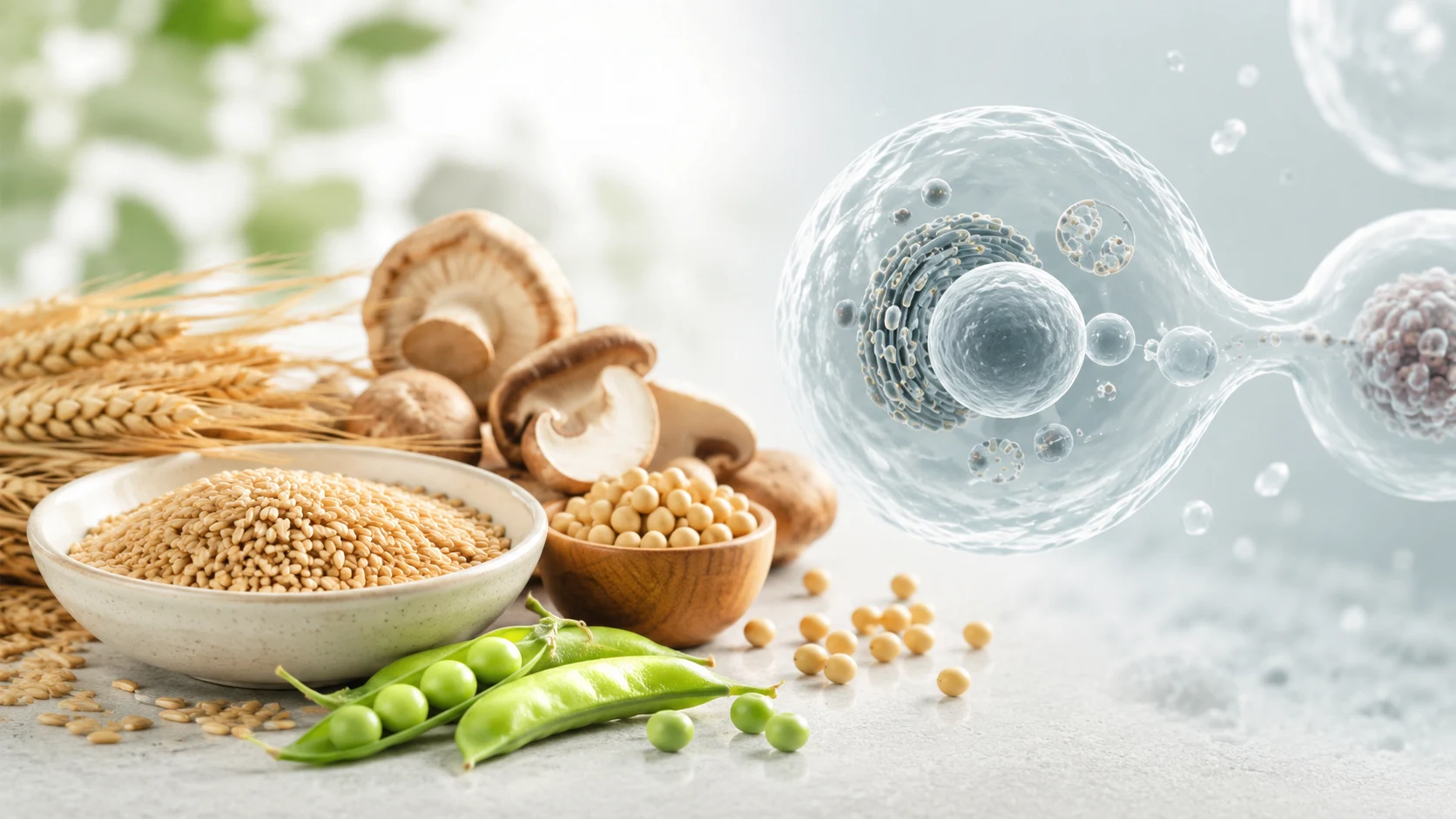
Spermidine is a polyamine — a class of small molecules involved in cell growth, DNA stability, and stress responses. It is produced naturally by the body and is also found in a range of foods, with particularly high concentrations in:
- Aged and fermented cheeses
- Wheat germ
- Mushrooms
- Soy products
- Legumes and green peas
Endogenous spermidine levels decline with age, which has led researchers to investigate whether maintaining or restoring higher levels — through diet or supplementation — could support cellular health and slow ageing processes.
Autophagy: A Brief Recap
Autophagy is the cellular process by which damaged proteins, dysfunctional organelles, and other cellular debris are broken down and recycled. It is not simply “on” or “off” — it exists on a spectrum and is regulated by nutrient status, stress signals, and key molecular pathways including mTOR and AMPK.
Autophagy declines with age, and this decline is associated with the accumulation of damaged cellular components that contribute to neurodegeneration, metabolic dysfunction, and other age-related conditions. Restoring or supporting autophagic activity is therefore a legitimate area of longevity research.
How Spermidine Triggers Autophagy
The Core Mechanism: mTOR Inhibition and ATG Activation
Spermidine appears to activate autophagy primarily through two interconnected mechanisms:
1. Inhibition of the mTOR pathway. mTOR (mechanistic target of rapamycin) is a central nutrient-sensing complex that suppresses autophagy when nutrients are abundant. Spermidine has been shown to reduce mTOR activity, which releases this suppression and allows autophagic processes to proceed. This is mechanistically similar to the effect of fasting or caloric restriction.
2. Upregulation of autophagy-related genes (ATGs). Spermidine increases the expression of several ATG proteins that are essential for forming and processing autophagosomes — the vesicles that capture and deliver cellular debris for degradation.
Additionally, spermidine inhibits the acetyltransferase EP300, an enzyme that suppresses autophagy. By blocking EP300, spermidine further shifts the cellular balance toward autophagic activity.
Does It Work Across Multiple Cell Types?
Research in cell models suggests spermidine activates autophagy in several tissue types, including neuronal cells, immune cells, and cardiac cells. This broad activity is consistent with the hypothesis that spermidine acts as a systemic autophagy inducer rather than a tissue-specific one, though the relative magnitude of effect likely varies by tissue and context.
What the Evidence Actually Shows
Animal Studies: Strong Signals, Significant Lifespan Effects
The most compelling evidence for spermidine comes from animal models. Studies in yeast, nematodes, flies, and mice have shown that spermidine supplementation extends lifespan — in some cases substantially — and that these effects are autophagy-dependent. When autophagy is genetically blocked in these organisms, the lifespan-extending effect of spermidine is largely abolished, providing strong mechanistic support for the link.
In mice, spermidine supplementation has been associated with improved cardiac function, reduced age-related inflammation, and enhanced memory performance — effects that appear tied to increased autophagic activity.
Human Evidence: Promising but Preliminary
Human data is more limited. Observational studies have found associations between higher dietary spermidine intake and reduced risk of cardiovascular disease and cognitive decline in older populations. A small number of clinical trials have shown improvements in cognitive function and cellular health markers in older adults following spermidine supplementation.
However, direct measurement of autophagy in human tissues remains technically difficult, and most human studies have used surrogate markers rather than confirmed autophagic flux. Human evidence is currently insufficient to make definitive claims about spermidine extending human lifespan, though the mechanistic plausibility and early clinical signals are notable.
Learn more in our complete guide to longevity.
Practical Implications: Diet, Supplements, and Timing
Dietary Sources First
Increasing spermidine intake through food is a reasonable and low-risk starting point. Wheat germ is among the richest dietary sources, with aged cheeses, mushrooms, and fermented soy products also contributing meaningfully. A diet that regularly includes these foods likely provides meaningful spermidine exposure without the need for supplementation.
Supplementation: What to Know
Spermidine supplements are available, typically derived from wheat germ extract. Doses used in clinical trials have generally ranged from approximately 1 to 6 mg per day. There is no established optimal dose for autophagy activation in humans, and higher doses have not been shown to be proportionally more effective.
Supplements may be useful for those who want a more controlled intake, but they should be viewed as a complementary option — not a replacement for foundational habits such as regular exercise, adequate sleep, and a nutrient-rich diet.
Combining Spermidine with Fasting or Exercise
There is theoretical and some mechanistic rationale for combining spermidine with intermittent fasting or exercise, both of which also promote autophagy through overlapping pathways. However, stacking autophagy-activating strategies does not necessarily produce additive benefits in a linear way, and the practical magnitude of any synergy in humans is not well established.
For context on how fasting duration affects autophagy, see our article on optimal fasting duration for autophagy.
Limitations and Honest Caveats
Several important limitations should temper enthusiasm about spermidine as a longevity supplement:
- Animal-to-human translation is uncertain. Lifespan studies in yeast, flies, and mice do not guarantee equivalent effects in humans, who have vastly more complex biology and longer lifespans.
- Human autophagy measurement is imprecise. Most human studies rely on blood-based biomarkers or indirect indicators rather than direct assessment of autophagic activity in target tissues.
- Long-term safety data in humans is limited. Short-term trials suggest spermidine is well tolerated, but multi-year safety profiles in supplemental doses have not been established.
- Maximising autophagy is not always the goal. Autophagy needs to be balanced with cellular growth, muscle protein synthesis, and recovery. Chronically high autophagic activity is not inherently desirable, particularly for older adults concerned about muscle mass. This trade-off is explored in more detail in our article on balancing autophagy and muscle growth.
Spermidine is best understood as a lower-confidence, mechanistically plausible option — worth considering as part of a broader strategy, but not a cornerstone of longevity on its own.
References and Resources
Key sources consulted in the preparation of this article on spermidine and autophagy:
Authoritative Sources on Spermidine and Autophagy
-
Autophagy and Aging: The Role of Spermidine
ncbi.nlm.nih.govA comprehensive review examining how spermidine influences autophagic pathways and its potential role in healthy ageing.
-
Spermidine as a Promoter of Autophagy in Cell Models
frontiersin.orgResearch examining spermidine-induced autophagy across multiple cell types and the molecular mechanisms involved.
-
Clinical Trials on Spermidine and Cellular Aging
pubmed.ncbi.nlm.nih.govA summary of human trial data examining spermidine supplementation and markers of cellular health and cognitive function.
-
Longevity and Spermidine: Mechanistic Insights
nature.comA landmark study detailing how spermidine extends lifespan in model organisms through autophagy-dependent mechanisms.
-
Spermidine Benefits and Sources
healthline.comAn accessible overview of spermidine’s dietary sources, proposed health benefits, and current evidence base.
-
Polyamines and Cellular Aging
oup.comA detailed paper on how polyamines including spermidine interact with autophagy pathways relevant to ageing biology.
-
American Society for Nutrition
nutrition.orgProfessional resources on dietary polyamines and their relationship to cellular health and autophagy.

-
Medical News Today
medicalnewstoday.comAn accessible review of spermidine’s proposed health benefits, including its autophagy-activating properties and dietary sources.
Frequently Asked Questions
Does spermidine actually activate autophagy?
Current evidence suggests yes. Spermidine has been shown in cell and animal studies to induce autophagy through mTOR inhibition and upregulation of autophagy-related genes. Human evidence supports this directionally, though direct measurement of autophagy in humans remains technically difficult and trials have been small.
How does spermidine activate autophagy at a molecular level?
Spermidine primarily activates autophagy by inhibiting mTOR signalling, which normally suppresses the autophagic process when nutrients are available. It also inhibits the enzyme EP300 and upregulates ATG proteins that are essential for autophagosome formation. These mechanisms closely resemble the autophagic response seen during fasting or caloric restriction.
Can spermidine activate autophagy in different tissues?
Research suggests spermidine activates autophagy across multiple tissue types including neuronal, cardiac, and immune cells. This broad activity may explain the range of health effects observed in animal studies, though the magnitude of effect in specific human tissues has not been fully characterised.
What scientific evidence supports spermidine’s role in autophagy?
The evidence is strongest in animal models, where spermidine supplementation consistently extends lifespan in an autophagy-dependent manner. Human observational data links higher dietary spermidine intake to lower cardiovascular and cognitive disease risk. Small clinical trials show improvements in cognitive and cellular health markers. Overall, the mechanistic evidence is solid; the human longevity evidence remains preliminary.
Is spermidine supplementation safe?
Short-term trials suggest spermidine is well tolerated at doses typically used in research (approximately 1–6 mg per day). Long-term safety data in supplemental doses is limited. As with any supplement, consulting a healthcare professional before starting is advisable, particularly for individuals with underlying health conditions or those taking medications.
Conclusion
Spermidine is one of the more mechanistically credible autophagy-activating compounds currently under investigation. Research clearly demonstrates its ability to induce autophagy through mTOR inhibition, ATG upregulation, and EP300 inhibition — and animal studies show genuine lifespan-extending effects tied to this activity.
Human evidence is directionally promising but not yet definitive. Spermidine should be positioned as a lower-confidence, complementary option within a broader longevity strategy — useful, potentially, but not a substitute for the foundational habits of regular exercise, quality sleep, and a nutrient-dense diet.
For those interested in autophagy as a longevity mechanism, spermidine is worth understanding. Whether through dietary sources or supplementation, maintaining adequate polyamine levels may support cellular maintenance as part of a balanced, evidence-informed approach to healthy ageing.
Find out more information about spermidine and autophagy
Search for more resources and information: