Does Protein Intake Block Autophagy?
Does Protein Intake Block Autophagy?
TL;DR: Protein intake suppresses autophagy by activating mTOR, but it does not block it permanently. The degree of suppression depends on the amount and timing of protein consumed — moderate, well-timed protein intake is unlikely to meaningfully disrupt autophagy during fasting periods.
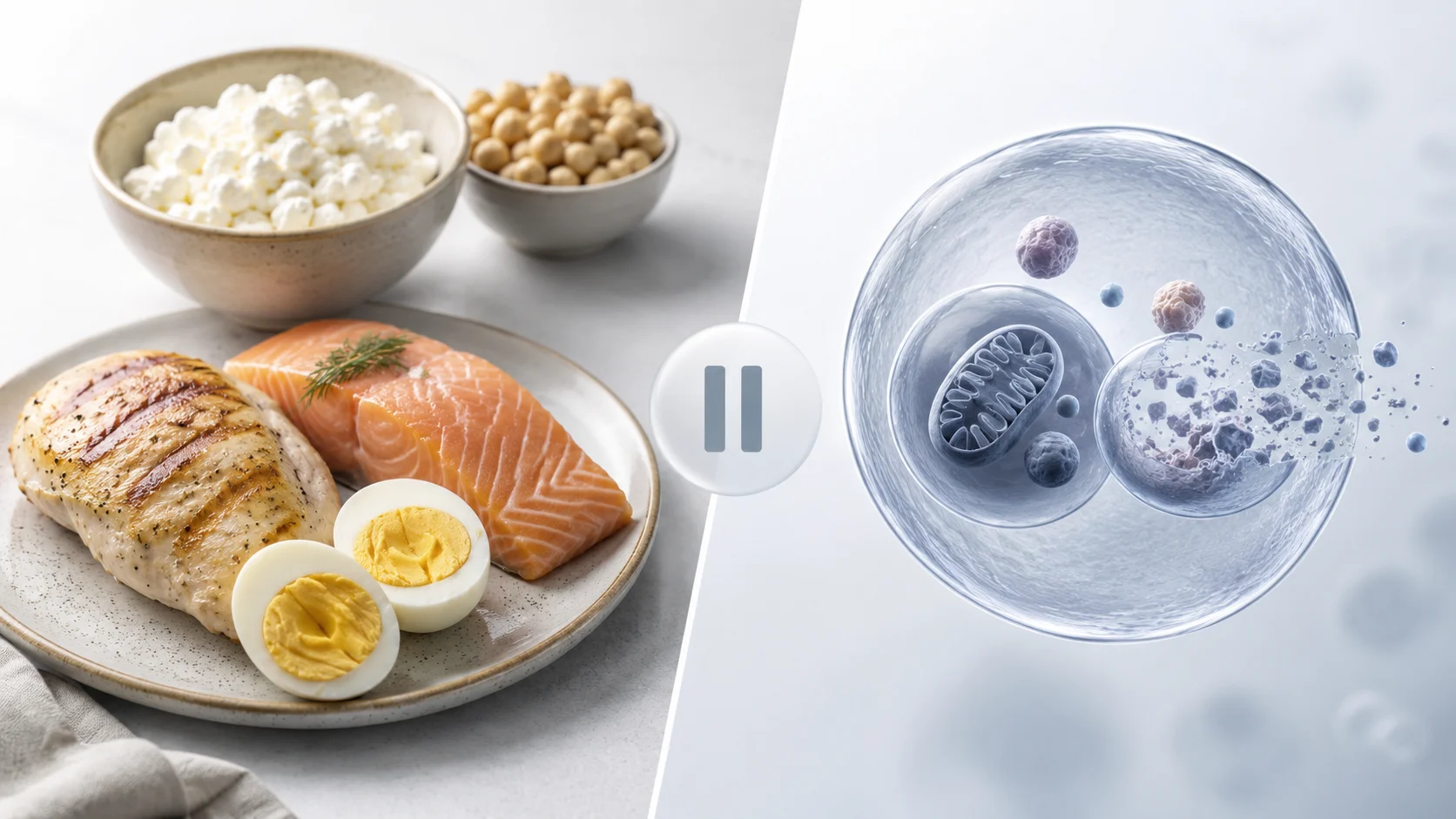
Yes, protein intake does suppress autophagy — but the effect is temporary and dose-dependent, not absolute. When you consume protein, the resulting rise in amino acids activates mTOR (mechanistic target of rapamycin), a key nutrient-sensing pathway that acts as a direct brake on autophagy. However, once amino acids are metabolised and mTOR activity falls, autophagy can resume. The picture is more nuanced than a simple on/off switch.
This matters because the relationship between protein and autophagy sits at the centre of a genuine trade-off in longevity biology: the same dietary protein that supports muscle preservation and healthy ageing also activates the pathway that suppresses cellular cleanup. Understanding this trade-off — rather than demonising protein — is what allows for smarter decisions around diet and fasting. For a broader view of autophagy within longevity, see our hub article on autophagy for longevity.
How Protein Suppresses Autophagy via mTOR
The mTOR Connection
Autophagy is regulated primarily through two opposing signalling pathways: mTOR, which promotes cell growth and suppresses autophagy when nutrients are available, and AMPK, which promotes cellular cleanup and energy conservation when nutrients are scarce.
Amino acids — particularly leucine, arginine, and glutamine — are among the most potent activators of mTOR complex 1 (mTORC1). When mTORC1 is active, it phosphorylates ULK1, a protein required to initiate autophagy, effectively putting the brakes on the process. This is not a malfunction; it is the body’s normal nutrient-sensing logic. When building materials are available, the priority shifts to growth and repair rather than recycling.
How Quickly Does Protein Suppress Autophagy?
Research suggests that amino acid-driven mTOR activation can occur within minutes to hours of protein consumption. However, mTOR activity typically returns toward baseline as amino acids are cleared from circulation. This means a protein meal suppresses autophagy transiently rather than chronically — provided protein is not being consumed continuously throughout the day.
The practical implication is that a person eating within a defined feeding window — as in 16:8 intermittent fasting — is likely experiencing meaningful periods of reduced mTOR activity and elevated autophagy during their fasting hours, even if protein is consumed during eating periods. Learn more in our complete guide to longevity.
Does All Protein Have the Same Effect?
Leucine and mTOR Activation
Not all protein sources trigger equal mTOR activation. Leucine is the most potent amino acid activator of mTORC1. Animal proteins — particularly whey, eggs, and meat — tend to be high in leucine and are absorbed rapidly, producing a stronger and faster mTOR response. Plant proteins generally have lower leucine content and slower absorption kinetics, which may produce a more modest mTOR signal, though the difference in autophagy outcomes has not been well characterised in humans.
Total Protein Load Matters More Than Source
Current evidence suggests that total daily protein intake and meal size are more relevant to mTOR suppression of autophagy than protein source alone. A large bolus of protein — regardless of type — is more likely to produce sustained mTOR activation than smaller, distributed amounts. This supports the idea that meal timing and portion size, rather than protein avoidance, are more practical levers for those who want to support autophagy without compromising nutrition.
Balancing Protein Intake and Autophagy
The Trade-Off With Muscle Preservation
This is where the biology becomes genuinely complex — especially for older adults. Adequate dietary protein is essential for maintaining muscle mass, which is one of the strongest predictors of healthy ageing and longevity. Sarcopenia (age-related muscle loss) is associated with increased risk of falls, metabolic dysfunction, and mortality. Aggressive protein restriction to maximise autophagy may therefore carry meaningful costs, particularly for people over 50 or those already at risk of muscle loss.
The idea that protein is simply “bad for longevity” because it activates mTOR is an oversimplification. mTOR signalling is also essential for muscle protein synthesis, immune function, and tissue repair. Chronically low mTOR activity — as seen with severe caloric restriction or pharmacological mTOR inhibition — has different and more complex effects than the transient, meal-driven mTOR fluctuations that occur with a normal eating pattern. For a detailed look at this balance, see our article on how to balance autophagy and muscle growth.
Does Protein Timing Affect Autophagy Meaningfully?
Concentrating protein intake within a defined eating window — rather than spreading it across the entire day — appears to allow more time for mTOR activity to fall and autophagy to increase during fasting periods. This is one of the theoretical benefits of time-restricted eating. However, direct human evidence demonstrating that protein timing meaningfully changes autophagy outcomes, rather than just changing mTOR signalling markers, remains limited. Much of the mechanistic evidence comes from cell and animal studies.
Practical Implications
What This Means in Practice
For most people who are not pursuing extended fasting, the relationship between protein and autophagy does not require drastic dietary changes. A few principles are worth keeping in mind:
- Fasting periods matter more than protein restriction. A meaningful fasting window — even 14 to 16 hours overnight — is likely to produce more autophagy than trying to minimise protein within a compressed eating window.
- Avoid continuous protein grazing. Spreading protein intake across many small meals throughout the day may sustain mTOR activation more persistently than eating protein within defined meals. Consolidating intake into two or three meals may allow more time for mTOR to fall.
- Protein needs are not optional, especially with age. Current evidence supports adequate protein intake — particularly in older adults — as a priority for maintaining muscle, metabolic health, and resilience. Sacrificing this to chase autophagy markers is not supported by long-term human evidence.
- The goal is periodic autophagy, not maximal autophagy. Autophagy is a normal process that cycles with feeding and fasting. Optimising its rhythm is more realistic and more evidence-based than attempting to maximise it continuously.
Limitations and Uncertainty
It is worth being clear about what the evidence does and does not show. Most human studies on autophagy measure proxy markers — such as LC3-II levels or p62 flux — rather than confirmed changes in disease risk or lifespan. The leap from “protein activates mTOR” to “protein shortens lifespan” is not well-supported by current human data. Observational studies on protein and longevity show mixed results, and the optimal protein intake for healthy ageing likely depends on age, activity level, and overall diet quality. You can explore the relationship between fasting duration and autophagy further in our article on optimal fasting duration for autophagy.
References and Resources
Authoritative Sources
-
Autophagy and Nutrient Sensing
nih.govDetails how amino acids and mTOR regulate autophagy, providing foundational mechanistic context for understanding how protein intake influences this process.
-
Autophagy and Fasting: How They Work Together
healthline.comAn accessible overview of how fasting influences autophagy and the role of dietary factors, including protein, in modulating this process.
-
Dietary Protein and mTOR Signalling
nih.govResearch examining how dietary proteins activate mTOR and influence cellular processes including autophagy, useful for understanding the nuances of protein timing and quantity.
-
Longevity and Autophagy
thelancet.comExplores how autophagy contributes to healthy ageing and how diet influences this process, including the role of amino acids and nutrient sensing.
-
The American Society for Nutrition
nutrition.orgA professional organisation providing research and guidelines on nutrition’s impact on health, including cellular processes such as autophagy.
-
Medical News Today
medicalnewstoday.comProvides accessible summaries of current research on diet, autophagy, and health, including the effects of protein consumption on cellular cleanup mechanisms.

Frequently Asked Questions
Does eating protein immediately stop autophagy?
Protein consumption raises amino acid levels, which activates mTOR and transiently suppresses autophagy. This suppression is temporary — once amino acids are metabolised and mTOR activity falls, autophagy can resume. The effect is meaningful in the short term but does not represent a permanent block.
Can I eat protein and still benefit from autophagy?
Yes. Consuming moderate protein within a defined eating window — particularly as part of an intermittent fasting approach — allows autophagy to increase during fasting hours. The key is avoiding continuous protein intake throughout the day, which may sustain mTOR activation more persistently.
Is the idea that protein blocks autophagy a myth?
Not exactly — protein does suppress autophagy via mTOR, and that mechanism is well established. But framing protein as simply “blocking” autophagy is an oversimplification. The effect is dose- and timing-dependent, and moderate protein intake is unlikely to meaningfully disrupt autophagy across a full day that includes a fasting window.
What are practical ways to support autophagy without restricting protein?
Prioritise a consistent fasting window — even 14 to 16 hours overnight — rather than cutting protein. Consolidate protein intake into defined meals rather than grazing throughout the day. For older adults especially, maintaining adequate protein for muscle preservation should take priority over aggressive restriction aimed at maximising autophagy markers.
Conclusion
Protein does suppress autophagy — via mTOR activation — but the effect is transient and context-dependent, not absolute. The more relevant question is not whether to eat protein, but how to structure eating patterns so that meaningful fasting periods allow autophagy to occur while adequate protein intake continues to support muscle mass and metabolic health.
The evidence does not support aggressive protein restriction as a longevity strategy. Instead, it points toward the value of periodic fasting, defined eating windows, and avoiding continuous protein grazing — approaches that allow the body to cycle between growth and repair states naturally. This rhythm, rather than maximising autophagy at all times, reflects how the biology is actually designed to work.
Find out more information about protein intake and autophagy
Search for more resources and information: