Does Resveratrol Activate Ampk?
TL;DR: Resveratrol does appear to activate AMPK, primarily in cell and animal studies, but the evidence in humans is inconsistent and the effects are modest. It is best viewed as a supplementary option within a broader lifestyle approach, not a standalone AMPK activator.
Does Resveratrol Activate AMPK?
Resveratrol can activate AMPK under certain conditions, but the evidence is more reliable in laboratory and animal models than in humans. Cell studies consistently show that resveratrol increases AMPK phosphorylation, a marker of AMPK activity. Human trials produce less consistent results, largely due to resveratrol’s poor bioavailability and the wide variation in supplement quality and dosage. The mechanism is plausible and scientifically grounded, but the practical magnitude of the effect in healthy adults remains uncertain.
What AMPK Does and Why It Matters
AMPK as the Body’s Energy Sensor
AMP-activated protein kinase (AMPK) functions as a cellular energy sensor. When energy availability falls — during fasting, caloric restriction, or intense exercise — the ratio of AMP to ATP rises, which triggers AMPK activation. Once active, AMPK promotes processes that generate energy, including fatty acid oxidation and mitochondrial biogenesis, while suppressing energy-consuming processes such as protein synthesis and fat storage.
AMPK activation also inhibits mTOR, a key regulator of cell growth. This suppression of mTOR creates conditions that favour autophagy — the process by which cells break down and recycle damaged components. This is why AMPK sits at the centre of research into fasting, cellular repair, and healthy ageing. For a broader view of how these pathways interact, see our guide to autophagy and longevity.
Why Resveratrol Is Connected to AMPK
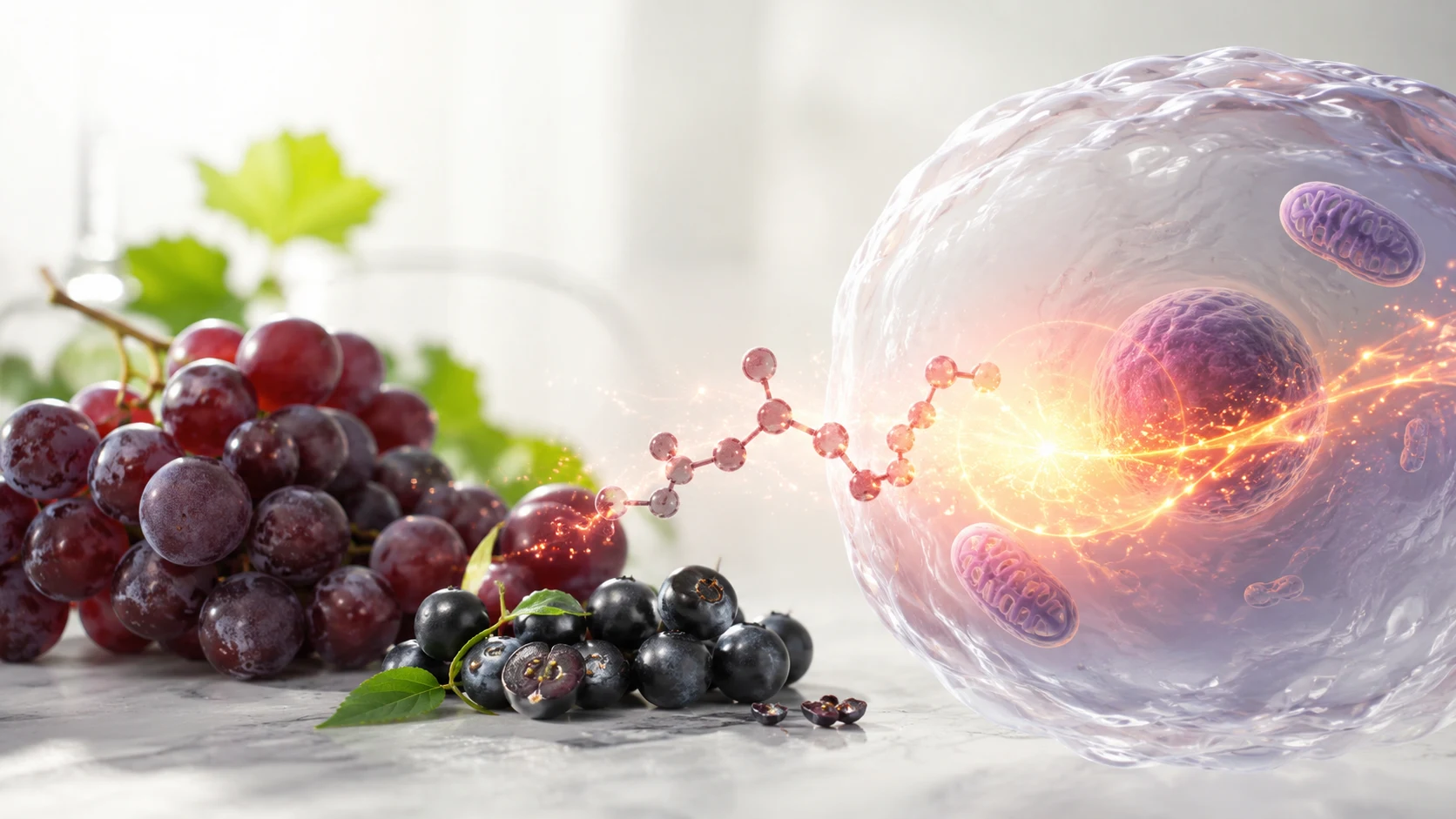
Resveratrol is a polyphenol found in red wine, grapes, and certain berries. It has attracted scientific interest because it appears to mimic some metabolic effects of caloric restriction — a state known to activate AMPK. Alongside its effects on AMPK, resveratrol also interacts with SIRT1, a longevity-associated protein that works in concert with AMPK in regulating metabolic function and stress response.
How Resveratrol Influences AMPK Activity
Direct Mechanisms
Research suggests resveratrol can raise the intracellular AMP/ATP ratio, which directly signals AMPK to activate. Some evidence also points to resveratrol inhibiting mitochondrial ATP synthesis at low levels — effectively creating a mild energy stress state that AMPK responds to. This is similar, in principle, to how metformin and berberine are thought to activate AMPK, though the magnitude and consistency differ.
Indirect Mechanisms via SIRT1
Resveratrol is a well-established activator of SIRT1, a deacetylase enzyme that interacts upstream of AMPK. SIRT1 can deacetylate and activate LKB1, a kinase that phosphorylates and activates AMPK. This indirect pathway suggests that resveratrol’s influence on AMPK may be partly mediated through SIRT1 rather than through direct AMPK binding. These two pathways likely work together, particularly when combined with dietary restriction or exercise — conditions that already raise AMPK activity independently. Learn more in our complete guide to longevity.
What the Scientific Evidence Shows
Cell and Animal Studies
In vitro studies consistently demonstrate that resveratrol increases AMPK phosphorylation in multiple cell types, including liver, muscle, and fat cells. Animal studies have shown improvements in insulin sensitivity, mitochondrial function, and markers of metabolic health following resveratrol administration — effects that align with AMPK activation. Some animal studies have also reported modest lifespan extension, though these findings have not translated reliably to mammals with more complex metabolic systems.
Human Evidence
Human evidence is limited and mixed. Some clinical trials in individuals with metabolic dysfunction — including type 2 diabetes or obesity — have observed improvements in insulin sensitivity and inflammatory markers following resveratrol supplementation, which may reflect AMPK involvement. However, well-controlled trials in healthy adults have produced less convincing results. A key challenge is bioavailability: resveratrol is rapidly metabolised and has low oral absorption, meaning the concentrations used in cell studies are difficult to achieve in human tissue through standard supplementation.
Comparison with Other AMPK Activators
Compared to berberine — another natural compound studied for AMPK activation — resveratrol has a weaker and less consistent human evidence base for direct AMPK effects. Fasting and exercise remain the most reliable and well-evidenced ways to activate AMPK in humans. Resveratrol may complement these approaches, but current evidence does not support it as a primary AMPK activator. For comparison, see our article on whether berberine activates AMPK.
Practical Implications and Limitations
Where Resveratrol May Have a Role
Resveratrol is most likely to show meaningful effects in people with existing metabolic dysfunction, where AMPK activity may already be impaired. In this context, it may act as a modest adjunct to dietary and lifestyle strategies. Research suggests that combining resveratrol with habits that naturally raise AMPK — such as intermittent fasting or aerobic exercise — may produce synergistic effects, though this has not been rigorously tested in controlled human trials.
Bioavailability and Dosage
Standard doses studied in clinical trials typically range from 150 mg to 1,000 mg per day. Formulations that improve absorption — such as micronised or liposomal resveratrol — may increase tissue availability, though even these do not guarantee meaningful AMPK activation in healthy tissue. Current evidence does not support a clear optimal dose for AMPK activation in humans.
Limitations and Uncertainty
The primary limitations of the current evidence are:
- Most mechanistic data comes from cell cultures or rodent models
- Human trials are small, short-term, and heterogeneous in design
- Bioavailability varies widely between individuals and formulations
- The degree of AMPK activation achievable through supplementation alone is unclear
Resveratrol should not be positioned as a reliable substitute for lifestyle-based AMPK activation. It is a lower-confidence option with a plausible mechanism but an incomplete human evidence base.
References and Resources
Authoritative Sources
-
Resveratrol and AMPK: Molecular Pathways
ncbi.nlm.nih.govA review covering the molecular mechanisms by which resveratrol influences AMPK activation, including direct and SIRT1-mediated pathways.

-
Resveratrol, SIRT1, and AMPK Interactions
sciencedirect.comAn analysis of the cross-talk between SIRT1 and AMPK in the context of resveratrol supplementation and metabolic regulation.
-
NIH: Resveratrol and Aging
nih.govAn overview of resveratrol research from the NIH, including its potential effects on longevity-related pathways.
-
Resveratrol Supplementation and Metabolic Health
pubmed.ncbi.nlm.nih.govA clinical trial examining the effects of resveratrol supplementation on metabolic markers in human participants.
-
WebMD: Resveratrol Benefits and Risks
webmd.comA general overview of resveratrol’s proposed health effects, including safety considerations and current evidence gaps.
-
Medical News Today: Resveratrol and Longevity
medicalnewstoday.comA review of resveratrol’s role in longevity research, including its interaction with ageing-related biological pathways.
-
Frontiers in Pharmacology: Resveratrol and Metabolic Regulation
frontiersin.orgA detailed pharmacological review of resveratrol’s effects on metabolic signalling, including AMPK and mTOR pathways.
Frequently Asked Questions
Does resveratrol activate AMPK in humans?
Evidence from cell and animal studies is consistent, but human data is limited and mixed. Some trials in people with metabolic dysfunction show relevant effects, while results in healthy adults are less clear. Bioavailability remains a significant barrier to reliable AMPK activation through standard supplementation.
How does resveratrol activate AMPK?
Resveratrol appears to raise the AMP/ATP ratio in cells, signalling an energy deficit that activates AMPK. It may also work indirectly by activating SIRT1, which in turn promotes AMPK activity through the LKB1 kinase pathway. Both mechanisms likely operate together.
Can combining resveratrol with fasting or exercise enhance AMPK activation?
Possibly. Fasting and exercise are the most reliable AMPK activators available. Resveratrol may complement these approaches by reinforcing the same signalling pathways, but there is limited controlled human evidence to confirm a meaningful additive effect.
Are there risks associated with resveratrol and AMPK activation?
Moderate doses of resveratrol are generally considered safe for most adults. High-dose supplementation has shown interactions with certain medications, including blood thinners. Consulting a healthcare provider is advisable before starting supplementation, particularly if you have existing health conditions or take prescribed medications.
Is resveratrol the best supplement for activating AMPK?
Current evidence suggests berberine has a stronger and more consistent human evidence base for AMPK activation than resveratrol. Neither supplement replaces the AMPK-activating effects of fasting and regular aerobic exercise, which remain the most evidence-backed approaches.
Conclusion
Resveratrol activates AMPK through plausible, well-described mechanisms — primarily by inducing mild cellular energy stress and by interacting with SIRT1. Cell and animal studies support this effect, and it aligns with resveratrol’s broader profile as a caloric restriction mimetic. However, translating these findings to reliable AMPK activation in healthy humans through standard supplementation remains uncertain. Bioavailability, dosage, and individual metabolic context all significantly influence the outcome.
Resveratrol is best understood as a lower-confidence supplement option within a longevity strategy — one that may offer some benefit, particularly in those with metabolic dysfunction, but should not be relied upon as a primary mechanism for AMPK activation or cellular repair. Fasting, exercise, and overall dietary quality remain far more impactful and better-evidenced approaches for supporting AMPK activity and long-term metabolic health.
Find out more information about resveratrol and AMPK
Search for more resources and information: