Does Playing a Musical Instrument Improve Brain Plasticity?
Introduction: The Link Between Playing Instruments and Brain Plasticity
TL;DR: Yes, playing a musical instrument can improve brain plasticity because it combines movement, listening, memory, timing, attention, and learning in one activity. Research suggests regular musical practice may strengthen neural connections, support cognition, and help maintain brain health across the lifespan.
Playing a musical instrument can improve brain plasticity by repeatedly challenging the brain to learn, adapt, coordinate, and remember. Instrument practice engages auditory, motor, visual, emotional, and executive brain systems at the same time, which is one reason it is often linked to stronger neural connectivity and better cognitive flexibility.
Brain plasticity, also called neuroplasticity, is the brain’s ability to change in response to experience. This matters for learning, memory, recovery after stress or injury, and healthy aging. Musical training is especially relevant because it is not passive. It requires precise movement, pattern recognition, timing, feedback, and repetition.
That combination helps explain why playing a musical instrument improves brain plasticity. It is both mentally demanding and physically coordinated, which makes it different from many other hobbies. For people interested in cognitive longevity, it can be a practical way to keep the brain active and adaptable. Learn more in our complete guide to longevity.
How playing a musical instrument improves brain plasticity
Harmonizing brain regions: the neuroplasticity effect
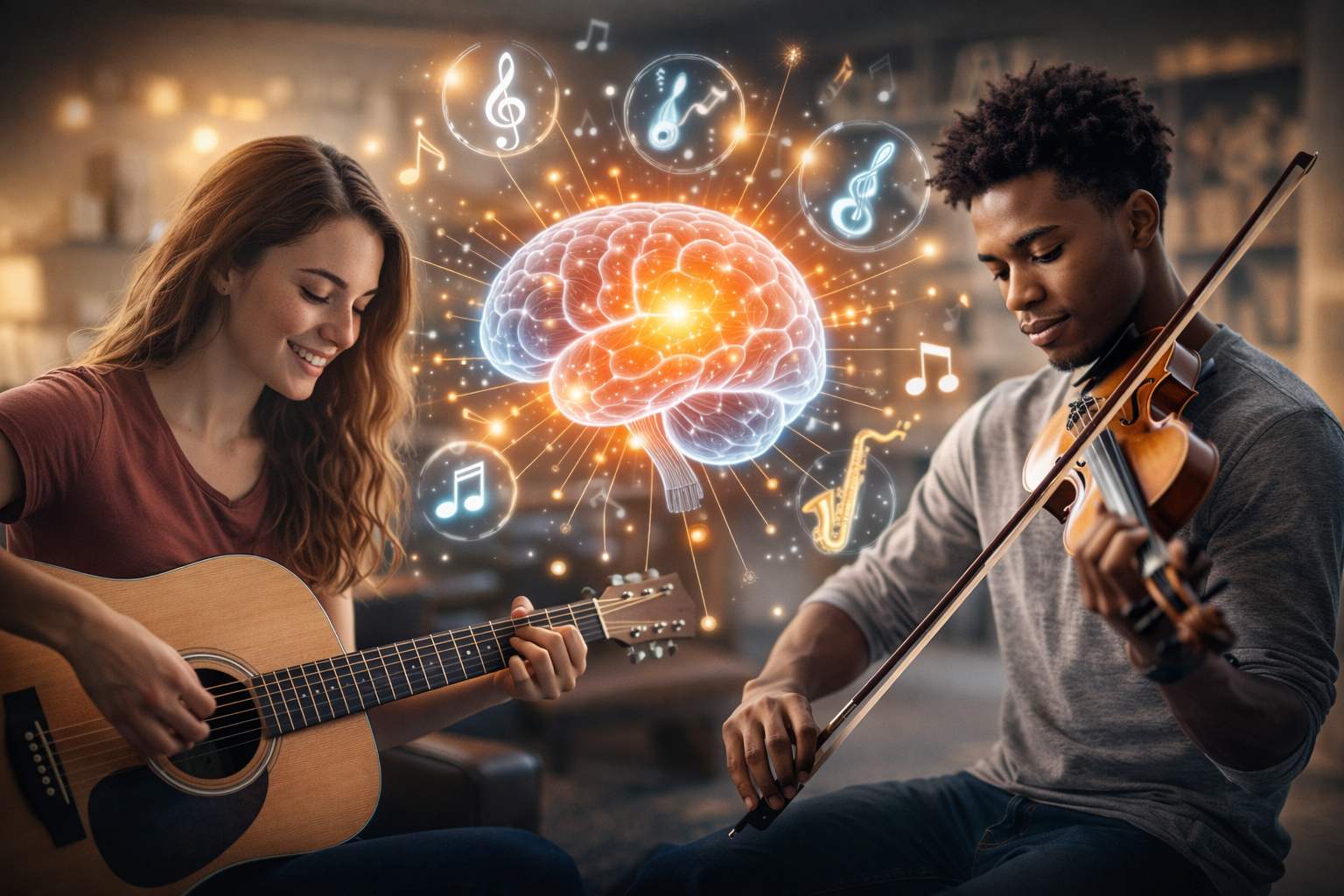
Musical practice activates multiple brain regions at once. A player has to hear pitch and rhythm, control movement, read notation or patterns, monitor mistakes, and adjust in real time. This creates a rich training effect that may help strengthen communication between different neural networks.
Research suggests that this kind of multisensory engagement supports neuroplasticity. The brain is not just storing notes. It is building and refining circuits related to auditory processing, fine motor control, attention, working memory, and timing. Over time, repeated use may improve efficiency in those pathways.
This is one reason playing a musical instrument improves brain plasticity. Few activities combine so many demands in such a structured and repeatable way. The more consistently a person practices, the more often the brain is asked to adapt.
The benefits of learning and repetition in brain adaptability
Repetition matters because neuroplastic change depends on practice. Each time a person rehearses a chord change, scale, rhythm pattern, or short musical phrase, the brain reinforces the circuits involved. This is how awkward movements become smoother and how unfamiliar sounds become recognizable.
Learning also matters. Simply repeating something easy has value, but the strongest stimulus often comes from working slightly beyond current ability. New songs, new rhythms, new fingerings, and new styles all create extra demand on the brain. That challenge may be especially helpful for maintaining cognitive flexibility with age.
In other words, playing a musical instrument improves brain plasticity not only because of repetition, but because of progressive learning. The most useful practice is regular enough to build skill and difficult enough to require adaptation.
What musical practice can do for learning, memory, and healthy aging
Why music can support cognitive growth
Musical training may support several aspects of cognition. It can challenge attention, sequencing, memory, auditory discrimination, and error correction. For children, this may help learning and skill development. For adults and older adults, it may help preserve mental sharpness and slow aspects of cognitive decline.
Research suggests musicians often show differences in brain structure or function compared with non-musicians, although this does not prove that music alone caused every benefit. Even so, the overall pattern supports the idea that sustained music practice is associated with a more adaptable brain.
There may also be emotional benefits. Playing music can improve mood, reduce stress, and create a sense of mastery. Lower stress and better emotional regulation can indirectly support brain health as well.
Observation of cognitive growth in real practice
People learning an instrument often notice improvements in concentration, timing, memory for patterns, and the ability to handle multiple streams of information at once. A pianist, for example, may read ahead, coordinate both hands, control rhythm, and listen critically all at the same time. A guitarist may combine finger placement, strumming patterns, tempo control, and auditory feedback in a similar way.
These demands help explain why playing a musical instrument improves brain plasticity. It continuously asks the brain to update performance based on feedback. That process of adjustment is central to learning.
This may also make music useful for healthy aging. Because instrument practice combines motor learning with cognitive effort, it can fit well into a broader plan for brain health, alongside exercise, sleep, social connection, and good metabolic health.
Practical ways to maximize brain plasticity through playing instruments
Consistent practice and progressive learning
The best way to support neuroplasticity through music is steady, deliberate practice. Short sessions done regularly are often more effective than occasional long sessions. Even 15 to 30 minutes most days can be enough to create meaningful progress.
Progression is important. Choose material that is challenging but manageable. If practice becomes too easy, the brain has less reason to adapt. If it becomes too difficult, frustration may reduce consistency. The goal is sustained challenge.
Useful strategies include learning a new song, increasing tempo gradually, practicing with a metronome, memorizing short sections, or improving accuracy before speed. These methods keep the brain engaged instead of relying on autopilot.
Engaging in diverse musical styles and techniques
Variety can enhance the effect. Exploring different genres, rhythms, and playing styles exposes the brain to new patterns and movement demands. Classical, jazz, blues, fingerstyle, improvisation, and rhythm work each challenge the brain in slightly different ways.
This is another reason playing a musical instrument improves brain plasticity. Novelty pushes the brain to update rather than simply repeat. Switching between reading music, playing by ear, improvising, and memorizing can create a broader training effect.
For some people, learning a second instrument may add even more variety. The exact choice matters less than consistent engagement, enjoyment, and a sense of challenge.
Making musical practice more brain-healthy
To get more out of practice, combine technical work with active listening and reflection. Record short sessions, identify mistakes, and adjust. Practice slowly enough to stay accurate. Pay attention to posture and hand comfort so training remains sustainable.
It also helps to pair music with healthy habits. Good sleep supports learning consolidation. Regular exercise supports blood flow and brain health. Stress management improves focus. Musical training works best when it is part of a wider healthspan routine rather than treated as a standalone solution.
Resources and studies supporting playing a musical instrument improves brain plasticity
These sources are useful for understanding why playing a musical instrument improves brain plasticity and how musical training may support learning, cognition, and healthy aging:
Authoritative Sources on Playing a Musical Instrument Improve Brain Plasticity
-
Music Training and Brain Plasticity
National Center for Biotechnology Information (NCBI)A peer-reviewed overview of how music training is linked to structural and functional brain changes related to neuroplasticity.
-
Neuroplasticity and Musical Training
MIT Journal of Cognitive NeuroscienceExplores how musical training can produce lasting neural adaptations across auditory, motor, and cognitive systems.
-
Music and Brain Plasticity
American Speech-Language-Hearing AssociationDiscusses how musical activity may promote neuroplasticity and support communication, learning, and rehabilitation.
-
Music and Brain Development
Science DailyA summary article describing research on how musical training may influence brain development and adaptability.
-
The Neuroscience of Music
Oxford Music OnlineProvides background on the neuroscience of music, including the relationship between musical practice, learning, and brain function.
-
Music Training and Cognitive Development
American Psychological AssociationExamines cognitive effects of music training and how practice may influence attention, memory, and adaptability.
-
Music and Neuroplasticity in Aging
Frontiers in NeuroscienceLooks at how musical activities may support neuroplasticity and cognitive resilience in older adults.

References and Resources
Overall, the evidence indicates that musical training can shape the brain in measurable ways. The exact size of the effect varies by age, practice intensity, and individual differences, but the direction is clear enough to make music a compelling brain-health activity.
For people interested in healthy aging, cognitive resilience, and lifelong learning, instrument practice stands out because it is enjoyable, skill-based, and sustainable. It trains the brain through repeated adaptation rather than passive stimulation.
Frequently Asked Questions
Can adults improve brain plasticity by learning an instrument?
Yes. Adults can still build new neural pathways through musical practice. Research suggests the brain remains capable of neuroplastic change across the lifespan, and instrument learning may support attention, memory, coordination, and cognitive flexibility.
Can playing an instrument help with neuroplasticity recovery after brain injury?
It may help as part of rehabilitation. Music-based therapy is sometimes used to support motor recovery, speech, and cognitive function. This should be guided by qualified professionals, especially after stroke or other neurological injury.
What are some practical tips to enhance brain plasticity through music?
Practice consistently, choose material that is slightly challenging, vary your repertoire, and combine repetition with novelty. Reading music, playing by ear, memorizing pieces, and trying new rhythms can all increase the training effect.
Does learning multiple instruments boost brain plasticity more?
It can, because different instruments create different motor and auditory demands. However, learning one instrument well also provides strong brain stimulation. The most important factor is sustained, engaged practice.
Is it too late to improve brain plasticity by playing an instrument?
No. It is not too late. Older adults can still benefit from musical learning, especially when practice is regular, enjoyable, and matched to current ability. Improvement may be slower than in childhood, but meaningful brain adaptation is still possible.
Conclusion
Playing a musical instrument can improve brain plasticity because it repeatedly trains the brain to listen, coordinate, remember, adapt, and refine. That combination makes music one of the most powerful and enjoyable forms of skill-based brain training available.
Research suggests musical practice may support learning, memory, emotional regulation, and healthy brain aging. It is not magic, and it does not replace sleep, exercise, or good metabolic health. But as part of a broader longevity strategy, it is a practical and rewarding way to keep the brain engaged over time.
Complex Motor Skill Learning Delay Brain Aging
Find out more information about “Playing a Musical Instrument Improve Brain Plasticity”
Search for more resources and information:
- 🔍 Search “Playing a Musical Instrument Improve Brain Plasticity” on Google
- 🔍 Search “Playing a Musical Instrument Improve Brain Plasticity” on Yahoo
- 🔍 Search “Playing a Musical Instrument Improve Brain Plasticity” on DuckDuckGo
- 📄 More about “Playing a Musical Instrument Improve Brain Plasticity” on this site