
How Often Should You Measure Vo₂ Max?
TL;DR: For most people focused on healthy aging, measuring VO₂ max once or twice per year is sufficient to track meaningful change. Those in structured training may benefit from testing every 6–12 weeks, aligned with training phases — but more frequent testing rarely adds actionable information and is not necessary for general longevity monitoring.
For longevity purposes, VO₂ max should typically be measured one to two times per year. This frequency is enough to detect clinically meaningful changes in cardiorespiratory fitness, which is one of the stronger predictors of long-term mortality risk currently available. Testing more often than this rarely changes what you should actually do — and for most people, it adds little value beyond reassurance.
What Is VO₂ Max and Why Does It Matter for Longevity?
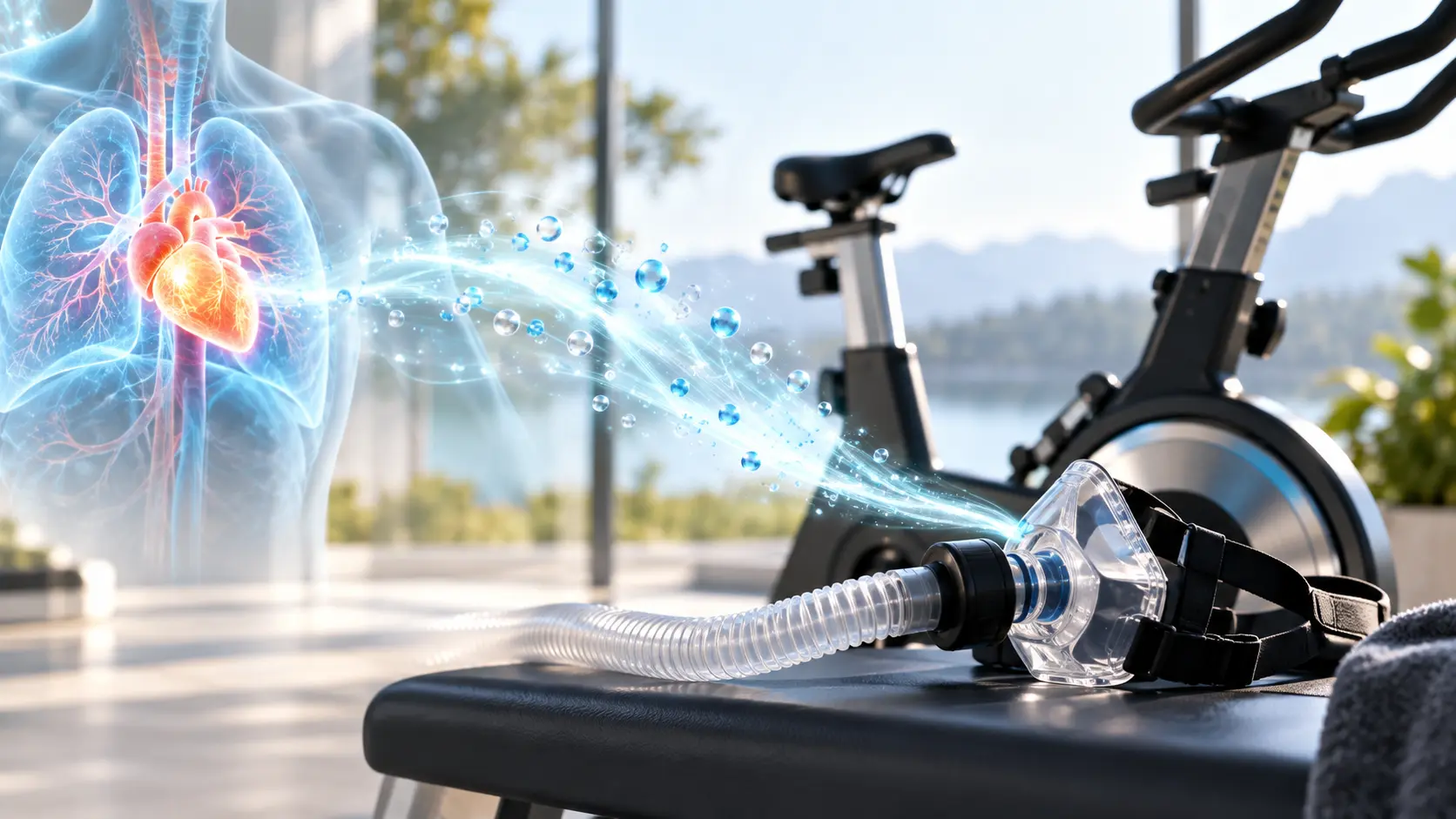
VO₂ max is the maximum rate at which your body can consume oxygen during sustained, intense exercise. In practice, it reflects how efficiently your heart, lungs, and muscles work together to generate energy aerobically. Higher VO₂ max values are consistently associated with lower all-cause mortality risk across large population studies.
Importantly, the relationship between cardiorespiratory fitness and mortality appears to be dose-dependent — moving from a low fitness category to a moderate one is associated with a substantial reduction in risk. This makes VO₂ max one of the more useful single metrics for assessing longevity risk, alongside markers like ApoB, HbA1c, and visceral fat.
That said, VO₂ max is one input among many. It reflects aerobic capacity specifically, and does not capture strength, metabolic health, inflammation, or other dimensions of healthspan. For a broader picture of what longevity testing involves, see our guide to longevity testing and trade-offs.
Factors That Influence How Often to Test
Training Phase and Goals
The most relevant factor in testing frequency is whether VO₂ max is actively being targeted by a training programme. If cardiorespiratory fitness is a current focus — for example, during a structured endurance block — testing every 6–12 weeks can help confirm whether training is producing the expected adaptation. However, if no specific aerobic training is underway, retesting within that window is unlikely to show meaningful change.
For competitive athletes or those in performance-oriented training, more frequent assessment may be justified. In contrast, for individuals focused on general health and healthy aging rather than athletic performance, annual or biannual testing is typically sufficient.
Baseline Fitness Level
Those who are deconditioned or returning to exercise after a significant break may see VO₂ max improve more rapidly in the early stages of training. As a result, more frequent testing in this phase — roughly every 8–12 weeks — can be informative. In more conditioned individuals, meaningful changes tend to accumulate more slowly, making frequent retesting less useful.
Method of Measurement
VO₂ max can be measured through a formal laboratory test (considered the gold standard), a submaximal clinical protocol, or estimated via wearable devices. Laboratory testing is more resource-intensive and typically reserved for structured programmes or clinical assessment. Wearable-based estimates are less accurate but can be monitored continuously without additional effort. It is worth being aware that consumer device estimates carry meaningful error margins and should not be treated as equivalent to lab-measured values.
Recommended Testing Frequency by Goal
For Longevity Monitoring (General Population)
For most adults using VO₂ max as a longevity biomarker rather than a performance tool, once or twice per year is a practical and evidence-consistent approach. Annual testing aligns well with a broader longevity review — for example, alongside a blood panel covering ApoB, HbA1c, CRP, and kidney and liver markers. This gives a more complete picture without creating an excessive testing burden.
Learn more in our complete guide to longevity.
For Structured Endurance Training
Those engaged in deliberate aerobic training — particularly higher-volume or higher-intensity programmes — may benefit from testing at the start, midpoint, and end of a training cycle. In practice, this typically means every 8–12 weeks during active training phases, with less frequent assessment during maintenance or off-season periods.
More frequent testing than this — for example, every 3–4 weeks — is generally not recommended. VO₂ max adapts gradually, and retesting too soon risks producing results that reflect daily variation or testing conditions rather than genuine fitness change.
For Those New to Exercise
Beginners may see relatively rapid improvements in the first several months of consistent aerobic training. Testing every 8–12 weeks during this phase can help confirm that the training approach is working and provide useful motivation. Once fitness begins to plateau, extending the interval to every 12–16 weeks is more appropriate.
For context on how VO₂ max fits within a broader longevity testing framework, see our article on what tests should be in a longevity blood panel.
Practical Considerations for VO₂ Max Testing
Standardise Conditions for Meaningful Comparisons
To make comparisons between tests reliable, conditions should be consistent across measurements. This includes using the same testing method each time, ensuring adequate rest beforehand, avoiding heavy training in the 24–48 hours prior, and testing at a similar time of day. Variability in any of these factors can shift results by several percentage points, making genuine change harder to detect.
Interpret Results in Context
A single VO₂ max score is most useful when interpreted against age- and sex-adjusted norms, and tracked over time rather than treated as a fixed number. A modest but consistent upward trend over one to two years is more meaningful than a single high or low reading. Conversely, a declining trend — even if values remain within a normal range — may warrant a closer look at training load, recovery, sleep, or metabolic health.
Avoid Over-Testing as a Default
More frequent testing does not improve outcomes on its own. For longevity purposes, the goal is to gather enough information to guide meaningful behaviour change — not to accumulate data for its own sake. If a VO₂ max result is not going to change what you do in the next three months, retesting in that window adds little value. This applies equally to other longevity biomarkers: the question is always whether a result is actionable, not simply measurable. For a broader discussion of this principle, see our guide to how often to run a longevity panel.
These are general patterns intended to inform the conversation with your own clinician or coach. Individual testing frequency should be agreed with a qualified professional based on your specific health status, training history, and goals.
Resources and Further Reading
The following sources provide evidence-based context on VO₂ max testing, its measurement, and its relevance to cardiovascular fitness and healthy aging.
Authoritative Sources on VO₂ Max Testing Frequency
-
ACE Fitness – How Often Should You Test Your VO₂ Max?
acefitness.orgPractical guidelines on testing frequency for athletes and fitness enthusiasts.
-
Verywell Fit – Understanding VO₂ Max
verywellfit.comAn accessible overview of VO₂ max, what it measures, and its role in fitness planning.
-
NCBI – VO₂ Max Testing and Training
nih.govA peer-reviewed article examining testing intervals and their relationship to training adaptation.
-
ACSM – American College of Sports Medicine
acsm.orgProfessional guidelines on fitness assessments, including VO₂ max protocols, for clinicians and practitioners.
-
Runner’s World – VO₂ Max Testing Frequency
runnersworld.comA practical guide for endurance athletes on when and how often to test for optimal training insight.
-
StrongFirst – Fitness Testing Resources
strongfirst.comInsights into testing protocols for strength and conditioning, including aerobic capacity assessment.
-
CDC – Measuring Physical Activity
cdc.govGeneral guidance on physical activity assessment and fitness measurement considerations from a public health perspective.
References
The following sources informed the content of this article and provide additional detail on VO₂ max measurement, cardiorespiratory fitness, and longevity-related testing.
Key References
-
ACE Fitness – How Often Should You Test Your VO₂ Max?
acefitness.orgPractical testing frequency guidelines for fitness and performance contexts.

-
Verywell Fit – Understanding VO₂ Max
verywellfit.comAn overview of what VO₂ max measures and its significance in fitness and health.
-
NCBI – VO₂ Max Testing and Training
nih.govPeer-reviewed research on testing intervals and aerobic training adaptation.
-
ACSM – American College of Sports Medicine
acsm.orgClinical guidelines on fitness assessment including VO₂ max testing standards.
-
Runner’s World – VO₂ Max Testing Frequency
runnersworld.comGuidance for endurance-focused individuals on practical testing schedules.
-
StrongFirst – Fitness Testing Resources
strongfirst.comProtocols and principles for fitness assessment in strength and conditioning settings.
-
CDC – Measuring Physical Activity
cdc.govPublic health guidance on physical activity measurement and fitness evaluation.
Conclusion
For most adults tracking VO₂ max as part of a longevity-focused health strategy, testing once or twice per year is appropriate. Those engaged in structured endurance training may benefit from more frequent assessment — typically every 8–12 weeks during active phases — but should avoid retesting so often that results reflect noise rather than real change. The key question before any retest is whether the result will actually inform a decision. If the answer is no, waiting is the more sensible choice. Overall, VO₂ max is a valuable marker, but its value lies in long-term trend tracking and guiding training priorities — not in frequent measurement for its own sake.
Find out more information about how often you should measure VO₂ max
Search for more resources and information: