Does Smoking Permanently Accelerate Lung Aging?
Does Smoking Permanently Accelerate Lung Aging?
TL;DR: Yes — smoking substantially accelerates lung aging by destroying lung tissue, reducing elasticity, and driving chronic inflammation. Quitting slows further decline and allows meaningful functional recovery, but structural damage — particularly from emphysema — is largely irreversible, especially after heavy or prolonged use.
Does Smoking Permanently Age the Lungs?
Smoking is the single most well-established accelerant of lung aging. Research consistently shows that smokers experience faster declines in lung function than non-smokers of the same age — a process driven by oxidative stress, chronic inflammation, and the physical destruction of lung tissue. Some of this damage is substantially reversible after cessation; some is not. The outcome depends heavily on how long and how heavily someone has smoked, and at what point they quit.
This article focuses specifically on how smoking affects the pace of lung aging, what the evidence says about recovery after quitting, and what that means in practical terms. For a broader look at how respiratory function changes with age and which interventions support it, see our guide to lung and respiratory longevity.
How Smoking Accelerates Lung Aging: The Mechanisms
Lungs naturally age from around the mid-twenties onward. FEV1 — the volume of air exhaled in one second, a key marker of lung function — declines at roughly 20–30ml per year in healthy non-smokers. In smokers, that rate can double or more, depending on smoking intensity and duration.
Several overlapping mechanisms drive this acceleration:
Oxidative stress. Cigarette smoke contains thousands of chemical compounds that generate reactive oxygen species. These damage cell membranes, DNA, and the structural proteins that give lung tissue its elasticity. Over time, this drives a state of sustained oxidative injury that outpaces the lungs’ repair capacity.
Chronic inflammation. Smoking triggers persistent inflammation in the airways and alveolar walls. Immune cells recruited to the lungs release enzymes — particularly matrix metalloproteinases — that break down elastin and collagen. This is the primary driver of emphysema, a condition in which the alveolar walls are progressively destroyed.
Airway remodelling. Repeated exposure to smoke irritants causes the airways to thicken and narrow through a process of fibrotic remodelling. This contributes to the airflow obstruction characteristic of COPD (chronic obstructive pulmonary disease).
Impaired mucociliary clearance. Cilia — the hair-like structures that sweep debris and pathogens out of the airways — are damaged by smoking. As a result, the lungs become less able to clear irritants and microbes, increasing infection risk and further driving inflammation.
Together, these mechanisms mean that smoking doesn’t merely mimic natural aging — it amplifies and accelerates it through processes that healthy aging alone does not trigger to the same degree. Learn more in our complete guide to longevity.
What Happens Inside the Lungs When You Smoke
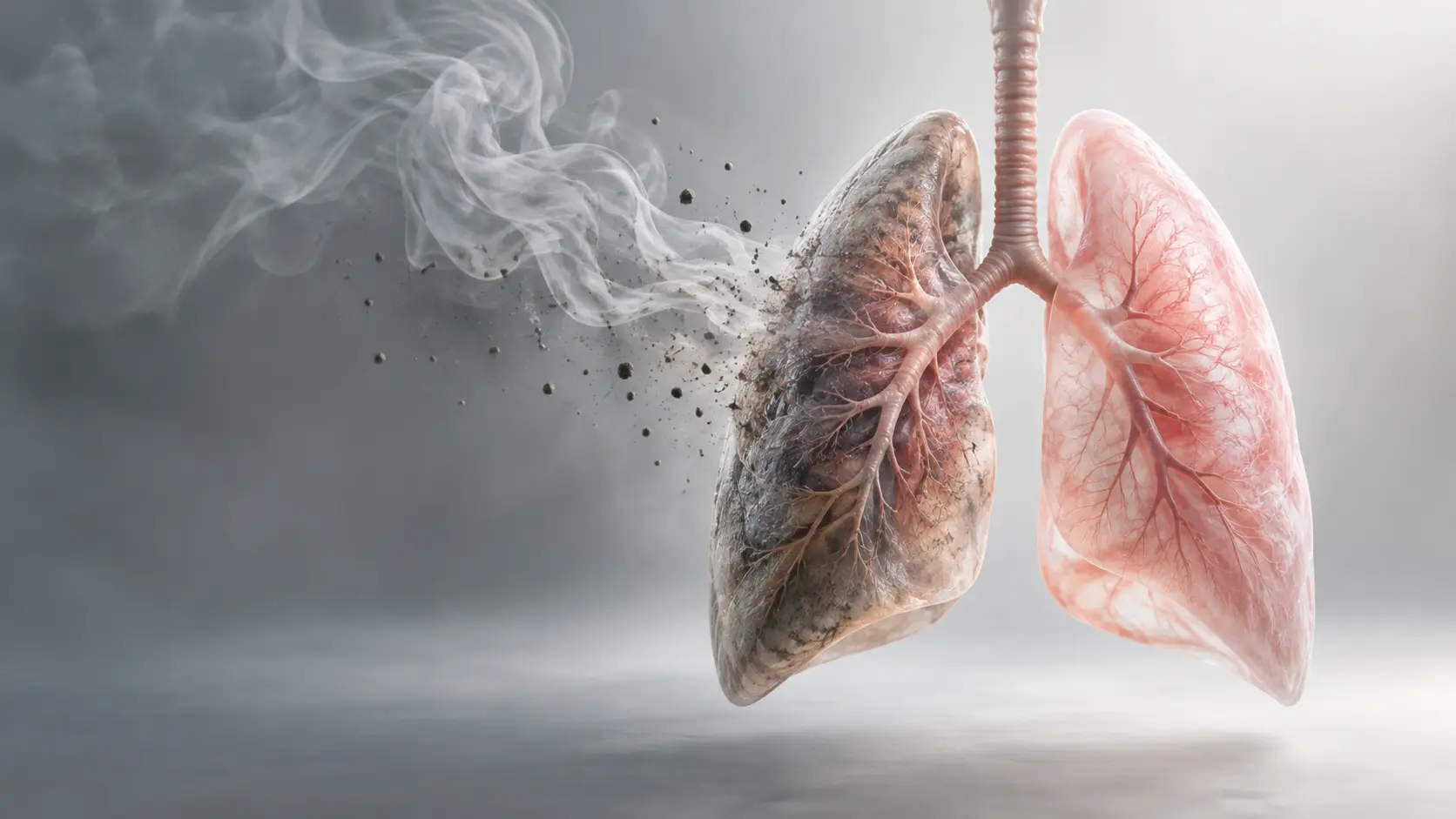
The structural consequences of chronic smoking are distinct from normal age-related lung decline. In emphysema — one of the most common smoking-related conditions — the alveolar walls that separate the tiny air sacs are destroyed. This reduces the total surface area available for gas exchange and causes the lungs to lose their elastic recoil, making it harder to exhale fully.
Unlike skin or the gut lining, alveolar tissue does not regenerate meaningfully once destroyed. This is a critical point: the loss of alveolar surface area is permanent. No intervention after cessation restores destroyed alveoli.
In chronic bronchitis — the other major component of COPD — the airways become persistently inflamed and produce excess mucus. Although some airway inflammation can improve after quitting, the structural narrowing caused by fibrotic remodelling tends to persist.
It is also worth noting that smoking-related lung aging increases cancer risk substantially. Carcinogens in cigarette smoke cause DNA mutations in airway epithelial cells, and impaired immune surveillance in damaged lung tissue allows abnormal cells to go unchecked for longer.
For context on how lung capacity changes with and without smoking, see our article on whether lung capacity declines with age.
Can Quitting Smoking Reverse or Slow Lung Aging?
Quitting smoking is the most impactful single action a smoker can take for lung health. However, the degree of recovery depends on the extent of damage already done.
What can improve after quitting:
Within weeks of stopping, airway inflammation begins to subside. Cilia start to recover function, improving mucus clearance and reducing infection risk. In smokers who quit before significant structural damage has occurred, the rate of FEV1 decline slows to roughly that of a non-smoker. Some functional lung capacity may also improve modestly as inflammation resolves and airways partially open.
What does not meaningfully reverse:
Destroyed alveolar tissue does not regenerate. If emphysema has developed, the loss of gas exchange surface area is permanent. Similarly, fibrotic remodelling in the airways is largely fixed. This means that long-term heavy smokers who quit may experience meaningful improvements in symptoms and slow the rate of further decline, but will not return to the lung function trajectory of a lifelong non-smoker.
The key variable is timing. Evidence indicates that smokers who quit in their thirties or forties — before significant emphysema has established — can preserve substantially more lung function over their lifetime than those who quit later. That said, quitting at any age reduces the rate of further decline and improves healthspan.
This distinction matters: quitting is not a cure, but it is the most effective intervention available and should not be delayed. The framing that damage is “done” and therefore quitting is pointless is not supported by the evidence.
What Helps After Quitting
Once someone has stopped smoking, the question becomes how to support the lungs that remain. The evidence here is more limited, but some interventions are genuinely useful.
Cardiovascular exercise is the most evidence-supported approach. Regular aerobic activity improves respiratory muscle efficiency, enhances oxygen extraction, and helps maintain VO2 max — all of which support functional capacity even when structural lung damage is present. Exercise does not repair alveoli, but it can meaningfully improve how well the remaining lung tissue is used.
Avoiding further respiratory insults matters considerably. This includes avoiding air pollution where possible, not taking up alternative tobacco or combustion products, and treating conditions like sleep apnea that place additional strain on respiratory function. Relevant to this, our article on whether air pollution reduces lung longevity covers the evidence on pollution exposure in more detail.
Pulmonary rehabilitation — a structured programme of breathing exercises and physical training — has good evidence for improving quality of life and exercise tolerance in people with established COPD, even though it does not reverse structural damage.
Nutritional support plays a secondary role. Antioxidant-rich diets may help reduce ongoing oxidative stress, though the effect size in former smokers is not well quantified in human trials.
In short: avoiding further damage and staying physically active are the two most actionable levers after cessation. Structural repair of the lungs is not currently achievable through lifestyle intervention.
Conclusion
Smoking substantially and measurably accelerates lung aging through mechanisms — alveolar destruction, chronic inflammation, airway remodelling — that go well beyond normal age-related decline. Some of this damage is partially reversible after quitting, particularly if cessation happens before structural disease is established. However, destroyed alveolar tissue does not regenerate, and significant emphysema represents a permanent reduction in lung function.
The practical takeaway is clear: quitting smoking at any age slows further decline and improves functional outcomes. Earlier cessation preserves more lung function. Staying physically active and avoiding further respiratory insults are the most useful steps after stopping. No supplement, breathing technique, or lifestyle intervention meaningfully restores lung tissue once it has been destroyed.

References and Resources
Authoritative Sources on Smoking and Lung Aging
-
CDC – Health Effects of Cigarette Smoking
cdc.govDetails how smoking damages lung tissue and accelerates functional decline, with emphasis on the importance of early cessation.
-
WHO – Tobacco and Lung Health
who.intGlobal data on tobacco use, accelerated lung aging, and the burden of respiratory disease attributable to smoking.
-
NHS – Chronic Bronchitis
nhs.ukExplains how smoking contributes to chronic bronchitis and its long-term effects on respiratory function.
-
NIH – Smoking and Lung Structure
nih.govResearch on the structural changes smoking causes in lung tissue, including the largely irreversible nature of alveolar destruction.
-
Mayo Clinic – Emphysema
mayoclinic.orgClinical overview of emphysema — its causes, mechanisms, and relationship to accelerated lung aging from smoking.
-
Asthma UK – Smoking and Lung Health
asthma.org.ukCovers the impact of smoking on respiratory disease and lung aging across different patient populations.
-
American Thoracic Society
thoracic.orgClinical research and professional guidelines on the long-term respiratory effects of smoking and strategies for management.
-
American Cancer Society – Lung Cancer Risks
cancer.orgOutlines how smoking-driven lung aging elevates cancer risk and what cessation can and cannot reverse.
-
WebMD – Lung Health Overview
webmd.comAccessible overview of lung anatomy, function, and how smoking accelerates age-related respiratory decline.
Find out more information about smoking and lung aging
Search for more resources and information: