Does Nad+ Improve Muscle Function?
Does NAD+ Improve Muscle Function?
TL;DR: NAD+ plays a genuine role in muscle energy metabolism and mitochondrial function, and age-related NAD+ decline may contribute to reduced muscle performance. However, while animal studies are encouraging, human evidence that NAD+ supplementation meaningfully improves muscle strength or recovery remains limited and early-stage.
Does NAD+ Improve Muscle Function?
NAD+ (nicotinamide adenine dinucleotide) is a coenzyme that muscle cells depend on for energy production, mitochondrial efficiency, and cellular repair. Evidence from animal models suggests that declining NAD+ levels contribute to age-related muscle deterioration, and that restoring those levels can improve mitochondrial function and endurance. In humans, early trials with NAD+ precursors such as NMN and NR show some promise, but the evidence is not yet strong enough to confirm meaningful improvements in muscle strength, mass, or recovery in healthy individuals.
The short answer: the biology is plausible and the early signals are interesting, but NAD+ supplementation has not been proven to reliably improve muscle function in humans.
How NAD+ Supports Muscle Biology
NAD+ and Mitochondrial Energy Production
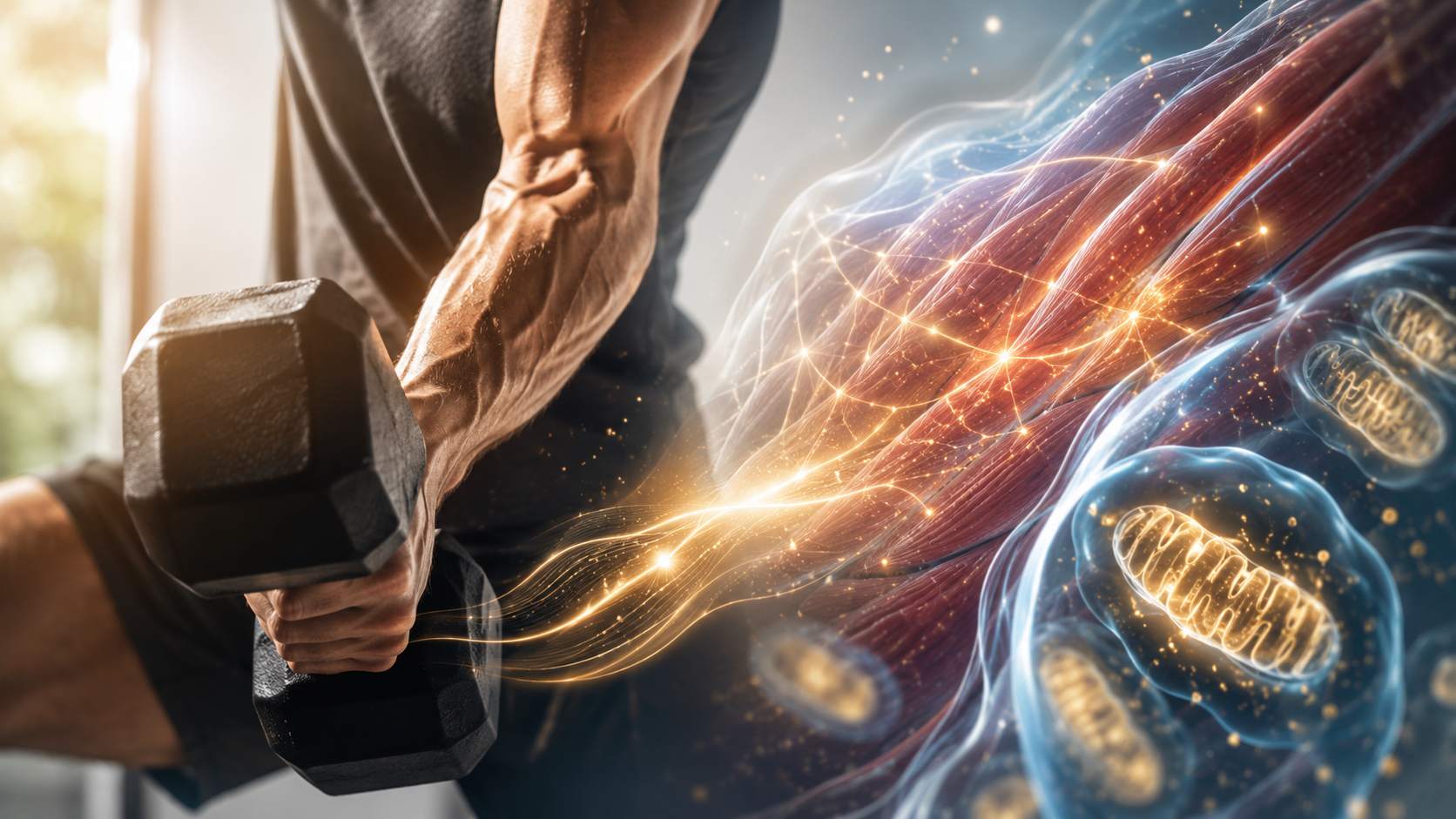
Muscles are metabolically demanding tissues. They rely on mitochondria to convert nutrients into ATP — the energy currency that powers contraction, endurance, and recovery. NAD+ sits at the centre of this process. It acts as an electron carrier in the mitochondrial electron transport chain, making it essential for oxidative phosphorylation and efficient energy output.
When NAD+ availability falls, mitochondrial function can become less efficient. This may reduce the capacity for sustained effort and slow recovery between sessions. Research suggests this is one of the mechanisms through which age-related NAD+ decline contributes to reduced muscle performance over time.
NAD+ in DNA Repair and Inflammation
Beyond energy production, NAD+ is consumed by enzymes involved in DNA repair — particularly PARPs — and by sirtuins, a family of proteins that regulate cellular stress responses, inflammation, and mitochondrial biogenesis. Both processes matter for muscle health. Accumulated DNA damage and chronic low-grade inflammation are associated with impaired muscle repair and progressive muscle loss with age, a condition known as sarcopenia.
By supporting sirtuin activity, adequate NAD+ levels may help maintain the cellular environment needed for effective muscle maintenance and recovery. Learn more in our complete guide to longevity.
The Aging Connection
NAD+ levels appear to decline with age, though the exact rate varies between tissues and individuals. In muscle tissue specifically, this decline has been associated with reduced mitochondrial density, lower endurance capacity, and accelerated sarcopenia in animal studies. Whether the same relationship holds consistently in humans is an active area of research. For a broader discussion of NAD+ decline with age, see our article on whether NAD+ declines after 30.
What the Research Actually Shows
Animal Evidence
The strongest evidence linking NAD+ to improved muscle function comes from animal models. Studies in aged mice show that supplementation with NAD+ precursors — particularly NMN and NR — can restore mitochondrial function in muscle tissue, improve endurance on treadmill tests, and partially reverse age-related muscle deterioration. These findings are mechanistically coherent and have been replicated across multiple research groups.
However, mice are not humans. Metabolic rates, supplement absorption, and tissue distribution differ significantly between species. Animal results establish biological plausibility, not clinical proof.
Human Trials
Human trials involving NAD+ precursors and muscle outcomes are limited in number, scale, and duration. Some studies in older adults have reported modest improvements in muscle endurance, reduced fatigue, and better performance on functional tests following NMN or NR supplementation. A small number of trials also show increases in NAD+ levels in muscle or blood following supplementation, which confirms that precursors can raise NAD+ in humans.
What is less established is whether those raised NAD+ levels translate into clinically meaningful improvements — in strength, muscle mass, exercise capacity, or long-term sarcopenia risk. Current evidence suggests possible benefits, particularly in older or less active individuals, but trials have generally been short, small, and focused on surrogate markers rather than hard outcomes.
For a closer look at how NMN and NR perform in raising NAD+ levels, see our supporting articles on whether NMN increases NAD+ levels and whether NR does the same.
Practical Implications for Muscle Health
Who May Benefit Most
The most plausible candidates for muscle-related benefits from NAD+ support are older adults experiencing age-related muscle decline, individuals with metabolic conditions affecting mitochondrial efficiency, and those with poor baseline NAD+ status. In these groups, addressing NAD+ insufficiency may have a more detectable effect than in younger, metabolically healthy individuals where NAD+ levels may already be adequate.
For healthy, active adults, the marginal benefit of supplementation is less clear. Exercise itself is one of the most effective known ways to support NAD+ biology in muscle tissue — through AMPK activation and increased demand on mitochondrial pathways. A diet that supports NAD+ precursor availability, alongside adequate sleep and metabolic health, may provide a meaningful foundation without supplementation.
Supplements as an Optimisation Layer
NAD+ precursor supplements — NMN and NR being the most studied — should be considered a possible optimisation layer, not a replacement for exercise, nutrition, and sleep. These lifestyle factors have stronger and more consistent evidence for preserving muscle function with age than any supplement currently available. If NAD+ supplementation has a role in muscle health, it is most likely as a supporting strategy alongside those fundamentals, not instead of them.
Dosing, timing, and product quality all vary significantly across available supplements. Consulting a healthcare professional before starting NAD+ precursors is advisable, particularly for individuals with existing health conditions or those taking other medications.
Limitations and Uncertainties
Several important limitations apply to the current evidence base:
- Trial duration: Most human studies have run for weeks to a few months. Long-term effects on muscle mass, strength, or sarcopenia risk are unknown.
- Sample sizes: Trials are generally small, which limits statistical confidence in the findings.
- Outcome measures: Many studies measure NAD+ levels as a biomarker rather than functional outcomes such as grip strength, muscle mass, or exercise capacity. Raising a biomarker does not automatically prove a functional benefit.
- Individual variation: Responses to NAD+ precursors appear to vary between individuals. Baseline NAD+ status, age, metabolic health, and genetics may all influence outcomes.
- Long-term safety: Short-term use of NMN and NR appears well-tolerated in available trials, but long-term safety data in humans is limited. This is an ongoing consideration, particularly at higher doses.
The broader NAD+ and longevity field is progressing quickly, but it remains an area where supplement marketing has moved ahead of proven human outcome data. Approaching NAD+ supplementation with realistic expectations and evidence-based thinking is important. For a full overview of this topic, see our hub on NAD+ for longevity.
References and Resources
Authoritative Sources on NAD+ and Muscle Function
-
NAD+ and Aging: The Therapeutic Potential
ncbi.nlm.nih.govThis review examines how NAD+ decline affects muscle aging and explores the potential of NAD+ restoration therapies.
-
NAD+ Precursors and Mitochondrial Health
pubmed.ncbi.nlm.nih.govExamines how NMN and NR supplementation can influence mitochondrial function, with relevance to muscle performance.
-
NAD+ Boosting Strategies in Aging
aging-us.comReviews NAD+ boosting methods and their effects on age-related decline, including muscle tissue.
-
NAD Precursors and Supplementation
healthline.comAn accessible overview of NAD+ precursors, their safety profile, and relevance to healthy aging.
-
Mitochondrial Function and NAD+ in Muscle Cells
nature.comResearch detailing the relationship between mitochondrial NAD+ metabolism and muscle strength and endurance.

Frequently Asked Questions
Frequently Asked Questions
Does NAD+ improve muscle function?
NAD+ plays a central role in mitochondrial energy production and cellular repair, both of which matter for muscle performance. Animal studies show clear benefits from restoring NAD+ levels in aged muscle tissue. Human evidence is more limited, but early trials suggest possible improvements in endurance and recovery, particularly in older adults. More robust human trials are needed before firm conclusions can be drawn.
Can NAD+ supplements help with muscle recovery?
Research suggests that NAD+ supports mitochondrial function and may help reduce oxidative stress following exercise. Some human studies report reduced fatigue and faster recovery in participants taking NAD+ precursors. However, the evidence is preliminary, and individual responses vary. NAD+ supplementation may offer modest recovery support, but should not replace fundamentals such as sleep, nutrition, and progressive training.
Is NAD+ supplementation safe for athletes?
Short-term use of NMN and NR at typical supplemental doses appears well-tolerated in available human trials, with no serious adverse effects reported. Long-term safety data in humans is limited. Athletes considering NAD+ precursors should consult a healthcare professional, particularly if they are subject to sporting regulations or have existing health conditions.
What is the best way to support NAD+ levels for muscle health?
Regular exercise — particularly resistance training and high-intensity cardio — is one of the most effective ways to support NAD+ biology in muscle tissue through AMPK activation. Adequate sleep, a nutrient-rich diet, and maintaining healthy metabolic function all contribute. NAD+ precursor supplements such as NMN or NR may offer additional support, especially in older adults, but the evidence for supplementation is weaker than for these lifestyle factors.
Conclusion
NAD+ has a well-established biological role in muscle energy metabolism, mitochondrial function, and cellular repair. Age-related NAD+ decline is a plausible contributor to sarcopenia and reduced exercise capacity, and animal studies provide meaningful support for the idea that restoring NAD+ levels can improve muscle performance.
In humans, the picture is more cautious. Early trials with NMN and NR show promising signals, but the evidence is not yet strong enough to confirm reliable improvements in muscle strength, mass, or recovery. Supplementation may be most relevant for older adults with declining muscle function, rather than healthy individuals with adequate NAD+ status.
For most people, exercise, sleep, and metabolic health remain the strongest tools available for preserving muscle function with age. NAD+ supplementation can be considered alongside these fundamentals — not instead of them — and with realistic expectations about what the current evidence supports.
Find out more information about NAD+ and muscle function
Search for more resources and information: