
What Is the Best Apob Optimization Plan?
TL;DR: The best ApoB optimization plan combines dietary changes (reducing saturated fat, increasing fiber), regular exercise, weight management, and medication when lifestyle changes alone are insufficient. The right combination depends on your baseline ApoB level, cardiovascular risk profile, and how your body responds to each intervention — which is why regular testing and clinical guidance are essential.
What Is ApoB and Why Does It Matter?
ApoB — apolipoprotein B — is a protein found on every atherogenic lipoprotein particle, including LDL, VLDL, IDL, and Lp(a). Because each particle carries exactly one ApoB molecule, measuring ApoB gives a direct count of how many atherogenic particles are circulating in the blood. This makes it a stronger predictor of cardiovascular risk than LDL cholesterol alone.
Evidence from large-scale studies consistently shows that higher ApoB concentrations are associated with increased risk of atherosclerosis and cardiovascular events. Atherogenic particles can penetrate arterial walls and contribute to plaque formation — and ApoB reflects that particle burden directly. For a deeper look at how this process works, see our article on whether ApoB causes plaque.
Understanding ApoB is the starting point for building a meaningful reduction strategy. The goal of optimization is not simply to hit a number, but to meaningfully reduce the atherogenic particle load driving long-term cardiovascular risk.
Can ApoB Levels Actually Be Optimized?
Is Meaningful Reduction Achievable?
Yes — ApoB levels can be meaningfully reduced in most people through a structured combination of lifestyle and, where appropriate, pharmacological interventions. The extent of reduction depends on baseline levels, genetic factors, and how consistently interventions are applied.
For individuals with mildly elevated ApoB, lifestyle changes alone can produce clinically significant improvements. For those with higher baseline levels or familial hypercholesterolaemia, medications such as statins or PCSK9 inhibitors are often necessary to reach target ranges. Neither approach is universally superior — the right plan depends on the individual’s risk profile.
What Does an Optimal ApoB Level Look Like?
Current evidence suggests that for individuals at elevated cardiovascular risk, an ApoB level below 65–70 mg/dL is associated with lower event rates. For lower-risk individuals, a target below 90 mg/dL is generally considered acceptable, though lower is typically better within a safe therapeutic range. For more detail on targets, see our supporting article on what constitutes an optimal ApoB level.
The Core Components of an ApoB Optimization Plan
An effective ApoB optimization plan addresses the main drivers of elevated particle count. These include:
- Diet: Saturated fat intake directly raises ApoB by upregulating hepatic LDL production. Refined carbohydrates and added sugars contribute via elevated triglycerides and VLDL output.
- Insulin resistance: Impaired insulin signalling increases hepatic VLDL secretion, raising ApoB independently of dietary fat intake. Research suggests that improving insulin sensitivity — through diet, exercise, or weight loss — reduces ApoB meaningfully.
- Body composition: Excess visceral adiposity is strongly associated with elevated ApoB. Weight loss, even modest amounts, consistently lowers ApoB in clinical studies.
- Medication: Statins reduce hepatic cholesterol synthesis and upregulate LDL receptor activity, lowering both LDL-C and ApoB. PCSK9 inhibitors further reduce LDL receptor degradation, achieving larger reductions. Ezetimibe and bempedoic acid are additional options in clinical use.
The most effective plan addresses as many of these levers as relevant to the individual, rather than relying on a single intervention.
Key Strategies: Diet, Exercise, and Medication
Dietary Changes
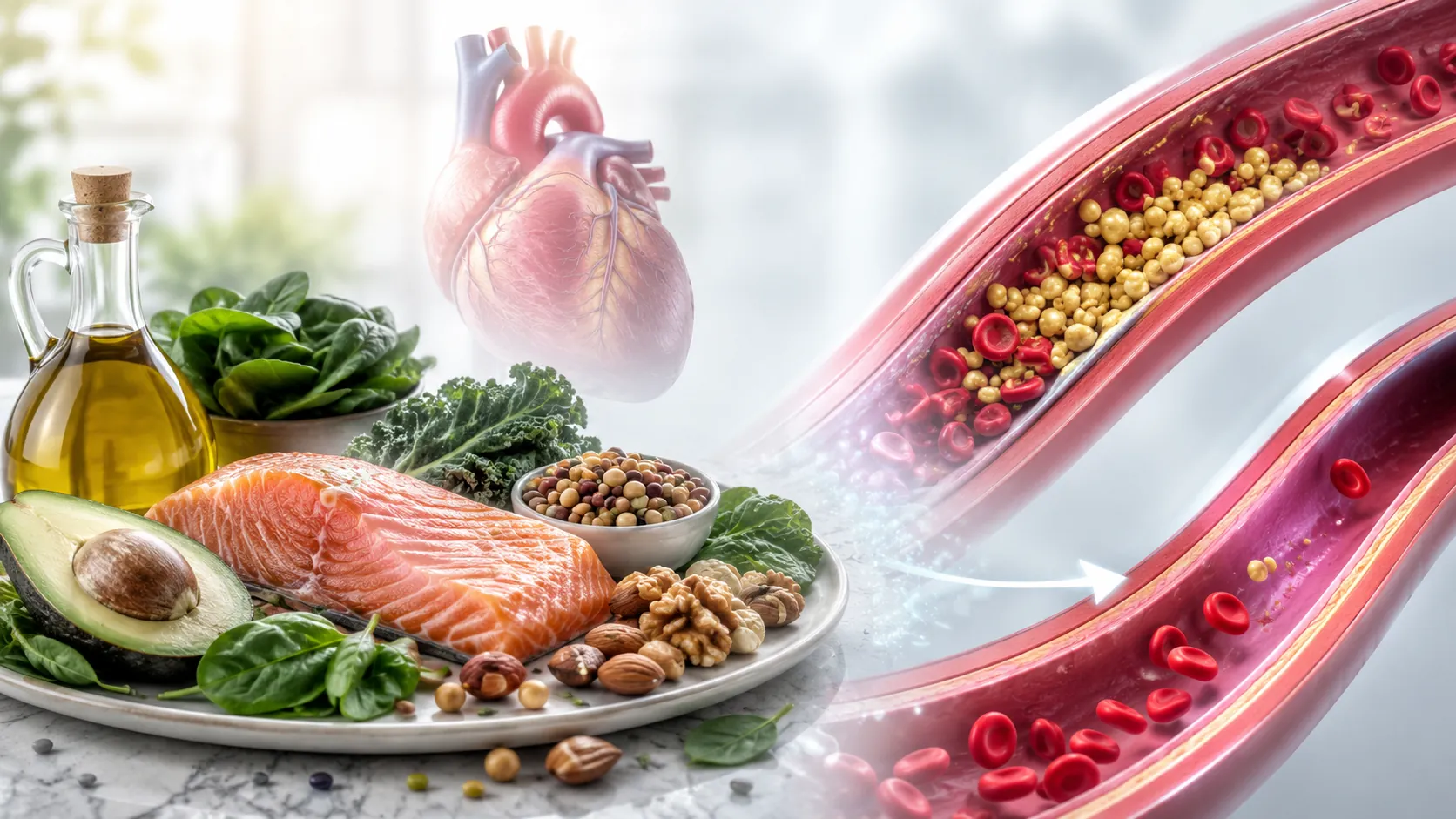
Reducing saturated fat intake is one of the most well-supported dietary strategies for lowering ApoB. Replacing saturated fats with unsaturated fats — found in olive oil, nuts, avocados, and oily fish — has been shown to improve lipid profiles without raising particle counts.
Increasing soluble fibre intake also supports ApoB reduction. Soluble fibre binds bile acids in the gut, reducing their reabsorption and prompting the liver to use more cholesterol for bile production — which lowers circulating ApoB-containing particles. Learn more about this mechanism in our article on whether fibre lowers ApoB.
A Mediterranean-style dietary pattern — emphasising vegetables, legumes, whole grains, fish, and healthy fats — aligns well with these principles and has a strong evidence base for cardiovascular risk reduction.
Exercise and Physical Activity
Regular aerobic exercise improves insulin sensitivity, reduces visceral fat, and modestly lowers ApoB directly. Resistance training contributes via improvements in body composition and metabolic health. Evidence supports a combination of both modalities for cardiometabolic benefit.
Current guidelines recommend at least 150 minutes of moderate-intensity aerobic activity per week, alongside two or more sessions of resistance training. Consistency matters more than intensity at the population level.
Medication When Necessary
When lifestyle changes are insufficient — or when baseline ApoB is substantially elevated — pharmacological intervention is appropriate and often necessary. Statins remain the most widely used first-line treatment, with strong evidence for ApoB and cardiovascular event reduction. PCSK9 inhibitors achieve greater reductions and are used in high-risk individuals or those intolerant to statins.
The decision to use medication should be made collaboratively with a clinician based on absolute cardiovascular risk, not ApoB values alone. Learn more in our complete guide to longevity at longevityinsights.co.uk/what-is-longevity.
Monitoring and Adjusting Over Time
How to Track Progress
ApoB is measured via a standard blood test and should be assessed at baseline before starting any intervention. Once a plan is underway, retesting every 3–6 months is reasonable to evaluate response and guide adjustments.
Advanced lipoprotein testing — such as NMR particle analysis — provides additional detail on particle size and concentration, but standard ApoB measurement is sufficient for most clinical decision-making.
Tracking related markers alongside ApoB is useful. These include fasting triglycerides, non-HDL cholesterol, fasting glucose, and HbA1c, which together provide a clearer picture of cardiometabolic status.
Adjusting the Plan Based on Results
If ApoB remains elevated after 3–6 months of consistent lifestyle intervention, the appropriate next step is to reassess dietary adherence, consider additional behavioural changes, or discuss pharmacological options with a clinician.
The plan should be treated as dynamic. Factors such as weight change, dietary shifts, new medications, or changes in metabolic health can all affect ApoB over time. Regular monitoring ensures the approach remains calibrated to current health status rather than fixed to an initial assessment.
For a broader look at how ApoB fits into overall cardiometabolic health, visit our hub page on the best cardiometabolic supplement stack.
References and Resources
Authoritative Sources on ApoB Optimization
-
American Heart Association — Cholesterol and Lipids
heart.orgComprehensive guidance on cholesterol, lipid management, and the role of ApoB in cardiovascular risk assessment.
-
Journal of Lipid Research — ApoB and Cardiovascular Disease
nih.govAcademic review of ApoB’s mechanistic role in atherosclerosis and its value as a cardiovascular risk marker.
-
Medscape — Lipid Management Guidelines
medscape.comClinical guidelines on lipid management, including ApoB targets and pharmacological treatment options.
-
WHO — Cardiovascular Diseases Fact Sheet
who.intGlobal epidemiological context for cardiovascular disease, highlighting the importance of lipid management in prevention.
-
PubMed — Lipoprotein Particle Testing
nih.govResearch on advanced lipoprotein particle testing methods, including NMR analysis and its clinical relevance for ApoB monitoring.
-
American Heart Association — Fats and Heart Health
heart.orgPractical guidance on dietary fat types and their effects on lipid profiles, including ApoB and cardiovascular risk.
-
CDC — Cholesterol Basics
cdc.govFoundational overview of cholesterol types and their relationship to ApoB and overall cardiovascular health.

-
Academic Journal — Lipoprotein Particle Size and Risk
nih.govStudy examining the significance of lipoprotein particle size in cardiovascular risk assessment and its relationship to ApoB measurements.
Frequently Asked Questions
What does the best ApoB optimization plan involve?
An effective ApoB optimization plan combines dietary changes (reducing saturated fat, increasing fibre and unsaturated fats), regular exercise, weight management, and medication where needed. The specific combination depends on baseline ApoB levels, overall cardiovascular risk, and individual response to each intervention. Working with a clinician to set targets and monitor progress is essential for sustained results.
Is it possible to optimize ApoB without medication?
For individuals with mildly elevated ApoB, lifestyle changes — particularly dietary modifications and regular exercise — can produce meaningful reductions without pharmacological support. However, for those with substantially elevated levels or high cardiovascular risk, medication is often necessary to reach clinically appropriate targets. A clinician can assess whether lifestyle intervention alone is sufficient based on individual risk.
How often should ApoB be tested?
Testing every 3–6 months is appropriate when actively managing ApoB levels, as this allows sufficient time to observe the effects of dietary or lifestyle changes and make informed adjustments. Once levels are stable within a target range, annual testing may be adequate depending on clinical guidance.
Are lifestyle changes enough to lower ApoB significantly?
Lifestyle changes are a meaningful and evidence-supported first step. Diet, exercise, and weight loss can each reduce ApoB independently, and their combined effect is greater. However, the magnitude of reduction varies considerably between individuals. Those with genetic predispositions to elevated ApoB — such as familial hypercholesterolaemia — typically require medication in addition to lifestyle interventions to reach optimal levels.
Conclusion
The best ApoB optimization plan is not a single protocol — it is a structured, evidence-based approach tailored to an individual’s risk profile, baseline levels, and response to intervention. Dietary changes, regular physical activity, and weight management form the foundation. Medication becomes appropriate when lifestyle measures are insufficient to reach clinically meaningful targets. Consistent monitoring every 3–6 months ensures the plan remains effective and can be adjusted as health status changes. The core principle is straightforward: lower ApoB reduces atherogenic particle burden, and reducing that burden over time meaningfully lowers long-term cardiovascular risk.
Find out more information about ApoB optimization
Search for more resources and information: