
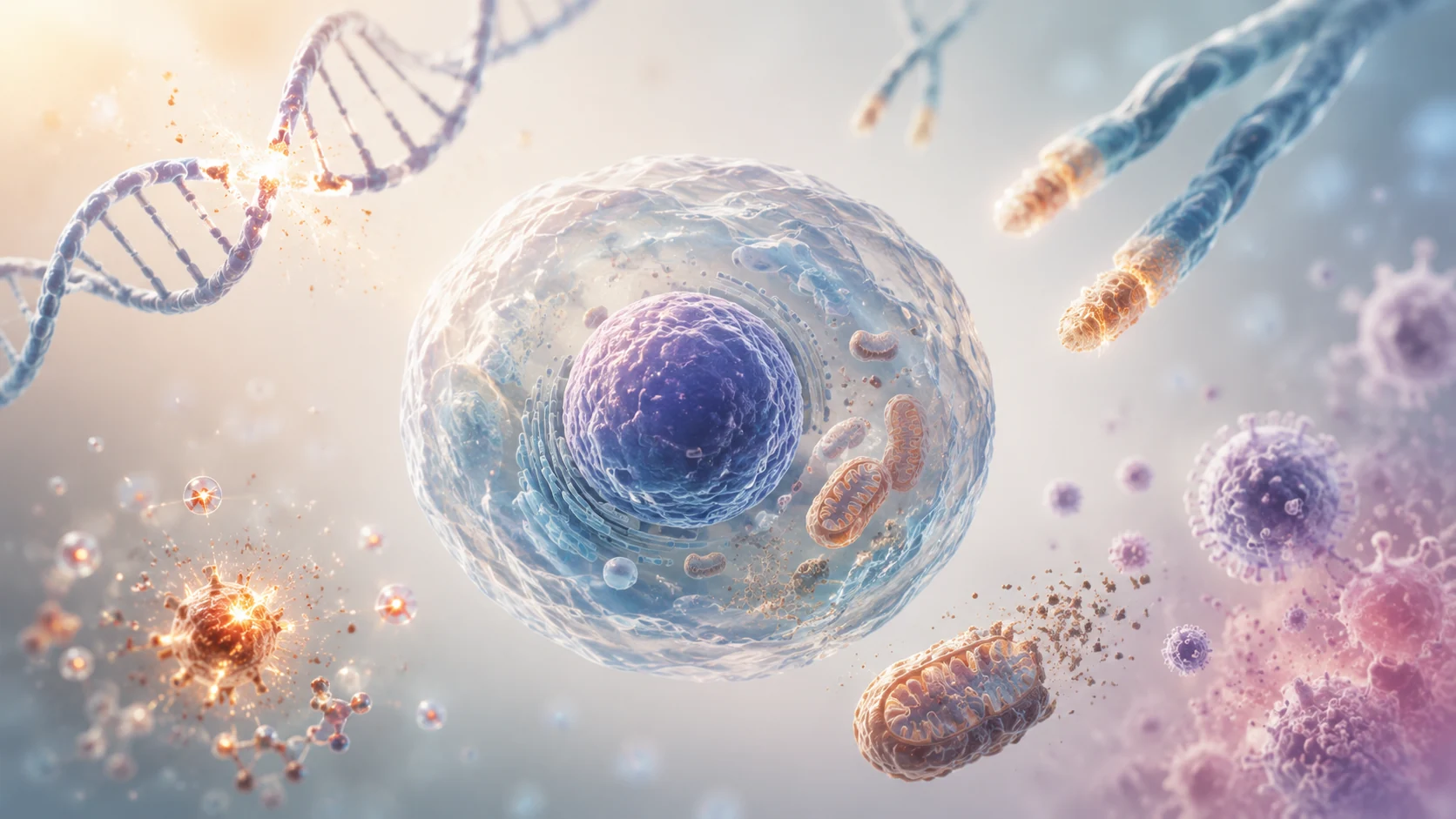
What Causes Cellular Senescence?
What Causes Cellular Senescence?
TL;DR: Cellular senescence is primarily triggered by DNA damage, oxidative stress, and telomere shortening — all of which signal a cell to permanently stop dividing. Chronic inflammation and environmental toxins can accelerate these triggers, causing senescent cells to accumulate faster with age.
Cellular senescence occurs when a cell permanently stops dividing in response to damage or stress. The most well-established triggers are DNA damage, oxidative stress, telomere shortening, and chronic inflammatory signalling. Each of these activates overlapping molecular pathways — particularly p53 and p21 — that enforce an irreversible growth arrest. Understanding what initiates this process helps explain why senescent cells accumulate with age and why that accumulation matters for long-term health.
What Causes Cellular Senescence?
Cellular senescence is not caused by a single event. Instead, it results from a range of cellular stresses that converge on a common outcome: permanent cell cycle arrest. The cell essentially shuts down replication to prevent damaged genetic material from being passed on — a protective response in the short term. However, when senescent cells accumulate over time without being cleared, they can impair tissue function and drive chronic inflammation.
The main recognised causes include DNA damage, excessive reactive oxygen species (ROS), telomere erosion, and sustained inflammatory signalling. Environmental exposures — such as radiation, toxins, and chronic infection — can accelerate all of these. In practice, these triggers rarely operate in isolation; they often reinforce one another in a cycle of increasing cellular stress.
For broader context on how senescence fits into the biology of ageing, see our article on what cellular senescence is and why it matters, and learn more in our complete guide to longevity at longevityinsights.co.uk/what-is-longevity/.
DNA Damage: The Primary Trigger
How DNA Damage Initiates Senescence
DNA damage is the most direct and well-studied cause of cellular senescence. When a cell’s DNA is damaged — by ionising radiation, chemical exposures, replication errors, or oxidative stress — the cell activates a damage response that halts the cell cycle. If that damage cannot be adequately repaired, the arrest becomes permanent and the cell enters senescence.
The key molecular actors here are the tumour suppressor protein p53 and its downstream target p21. Together, they act as a checkpoint, preventing a damaged cell from dividing and potentially propagating mutations. This is, importantly, a cancer-protective mechanism. However, the same process becomes problematic when triggered repeatedly across many cell types over decades of life.
Double-strand breaks in DNA are particularly potent senescence inducers. These can arise from replication stress — errors that occur when DNA is copied during cell division — or from external insults. Research suggests that persistent DNA damage signalling, even from low levels of unrepaired breaks, is sufficient to maintain the senescent state long-term.
Oxidative Stress and Reactive Oxygen Species
ROS as Accelerators of Cellular Ageing
Reactive oxygen species are chemically reactive molecules produced as natural byproducts of cellular metabolism, particularly in the mitochondria. At low levels, ROS play signalling roles. At elevated levels, however, they cause oxidative damage to DNA, proteins, and lipid membranes — and this damage directly triggers senescence pathways.
Oxidative stress increases with age due to declining mitochondrial efficiency, reduced antioxidant capacity, and accumulated metabolic dysfunction. As a result, ROS-driven senescence becomes more frequent over time. Environmental factors — including cigarette smoke, air pollution, ultraviolet radiation, and processed foods — further amplify oxidative burden.
Evidence from both cell culture and animal studies consistently links oxidative stress to accelerated senescence. In human biology, elevated markers of oxidative damage are associated with higher burdens of senescent cells in tissues. That said, antioxidant supplementation alone has not been shown to reliably reverse or prevent senescence in humans, which suggests the relationship is more complex than simple ROS neutralisation.
Telomere Shortening and Replicative Senescence
The Hayflick Limit and Telomere Erosion
Telomeres are protective caps at the ends of chromosomes that shorten slightly with each cell division. Once they reach a critically short length, the cell interprets this as a form of DNA damage, triggering the same p53/p21 pathway that enforces senescence. This is known as replicative senescence — the phenomenon originally described by Leonard Hayflick, who observed that normal human cells have a finite capacity to divide.
Telomere shortening is therefore a natural and unavoidable contributor to senescence over a lifetime of cell division. However, the rate at which it occurs is not fixed. Chronic psychological stress, poor metabolic health, smoking, obesity, and systemic inflammation are all associated with accelerated telomere attrition. In contrast, regular physical activity and dietary patterns associated with reduced inflammation appear to correlate with slower telomere shortening in observational research.
It is worth noting that telomere length alone is an imperfect biomarker. Short telomeres increase senescence risk, but the functional consequences depend on which tissues are affected and how effectively the immune system clears the resulting senescent cells.
Chronic Inflammation and Environmental Triggers
Inflammation as Both Cause and Consequence
Chronic low-grade inflammation — sometimes called inflammaging — is both a driver and a downstream consequence of cellular senescence. Inflammatory cytokines, particularly those produced during states of obesity, metabolic dysfunction, chronic infection, or autoimmune activity, can directly induce senescence in otherwise healthy cells by generating DNA damage and activating stress response pathways.
This creates a feedback loop. Senescent cells themselves secrete a pro-inflammatory mixture of cytokines, proteases, and growth factors known as the senescence-associated secretory phenotype (SASP). The SASP can, in turn, push neighbouring cells into senescence — a process called paracrine senescence — while also sustaining the inflammatory environment that triggered the original senescent cells. Over time, this cycle amplifies the senescent cell burden in tissues.
Environmental toxins contribute to this picture. Heavy metals, industrial chemicals, particulate air pollution, and cigarette smoke all generate oxidative stress and DNA damage, accelerating senescence in exposed tissues. Limiting these exposures is therefore a meaningful, if often underappreciated, part of reducing senescence burden over a lifetime.
For a detailed explanation of how the SASP drives downstream harm, see our article on what the SASP is and how it affects ageing tissues.
Stress-Activated Signalling Pathways
p53, p21, and the RB Pathway
At the molecular level, most senescence triggers converge on two key pathways: the p53–p21 axis and the p16–RB axis. Both enforce cell cycle arrest by different mechanisms, and both can be activated simultaneously or in sequence depending on the nature of the stress.
The p53–p21 pathway responds primarily to acute damage, including DNA breaks and oxidative insults. It is generally considered the earlier and more reversible of the two responses. The p16–RB pathway, in contrast, is associated with a deeper, more stable form of senescence and is typically activated later or in response to prolonged stress. Elevated p16 expression is widely used as a molecular marker of senescent cell accumulation in human tissues.
Oncogene-induced senescence is a further distinct mechanism. When a proto-oncogene is abnormally activated — as can occur in early cancer development — cells may enter senescence as a protective response to prevent malignant transformation. This highlights the dual role of senescence: protective in the short term, but potentially damaging when the resulting senescent cells are not cleared efficiently.
Practical Implications
Understanding the causes of cellular senescence has direct relevance to how lifestyle choices affect long-term health. While it is not possible to eliminate senescence — nor would that be desirable given its cancer-protective roles — several evidence-supported behaviours are associated with reducing the rate at which senescent cells accumulate.
Regular aerobic and resistance exercise reduces systemic inflammation, improves mitochondrial function, and supports immune surveillance — all of which are relevant to senescence burden. Dietary patterns that lower chronic inflammation and maintain metabolic health may slow both telomere erosion and ROS-driven damage. Adequate sleep supports DNA repair processes that are critical to preventing the kind of persistent damage that induces senescence.
In contrast, smoking, obesity, chronic psychological stress, and high exposure to environmental pollutants are among the most reliably documented accelerators of the senescence triggers described above. Addressing these factors represents the most practical and evidence-supported approach to managing senescence-related ageing — well ahead of any pharmacological intervention.
Emerging senolytic compounds such as quercetin, fisetin, and rapamycin are being investigated for their ability to selectively clear existing senescent cells. However, the human evidence for these approaches remains limited, and they should not be considered a substitute for the lifestyle foundations described above. For an overview of the senolytic landscape, see our article on what senolytics are and how they are intended to work.
References and Resources
Sources on the Causes of Cellular Senescence
-
The Role of DNA Damage in Cellular Senescence
nature.comExplores how DNA damage triggers cellular senescence and its implications for ageing and cancer prevention.
-
Oxidative Stress and Aging
cell.comReviews the relationship between reactive oxygen species, oxidative damage, and the onset of cellular senescence.
-
Telomeres and Cellular Aging
sciencedirect.comAn in-depth examination of telomere dynamics and their role in driving replicative senescence in ageing tissues.
-
Inflammation and Cellular Aging
nih.govProvides evidence on how chronic inflammation acts as a senescence trigger and potential approaches to reduce this burden.
-
Understanding Cellular Senescence
ama-assn.orgA clinical overview of cellular senescence, its causes, and its relevance to age-related disease.
-
National Institute on Aging Resources
niaid.nih.govA trusted source for current research on cellular ageing mechanisms and senescence-related interventions.
-
Trends in Cell Biology Journal
cell.comFeatures peer-reviewed reviews on senescence mechanisms, triggers, and emerging research on cellular ageing.

-
Inflammaging and Cell Senescence
nature.comDiscusses how chronic low-grade inflammation contributes to senescence accumulation and accelerated biological ageing.
Frequently Asked Questions
What are the main causes of cellular senescence?
The primary causes are DNA damage, oxidative stress, telomere shortening, and chronic inflammatory signalling. These triggers activate molecular pathways — principally p53/p21 and p16/RB — that enforce permanent cell cycle arrest. In practice, these causes often overlap and reinforce one another, particularly in ageing tissues.
How does oxidative stress cause cellular senescence?
Oxidative stress arises when reactive oxygen species exceed the cell’s antioxidant capacity, causing damage to DNA, proteins, and membranes. This damage activates the same senescence pathways triggered by other forms of cellular injury. Mitochondrial dysfunction and environmental exposures — such as smoking and pollution — are among the main drivers of elevated oxidative stress.
Can environmental toxins cause cellular senescence?
Yes. Exposure to pollutants, heavy metals, cigarette smoke, and industrial chemicals generates oxidative stress and direct DNA damage, both of which are established senescence triggers. Reducing these exposures over time is a practical way to lower the cumulative senescence burden in tissues.
Is telomere shortening a cause of cellular senescence?
Yes. Telomeres shorten with each cell division, and when they reach a critically short length, the cell interprets this as DNA damage and enters senescence. This process — replicative senescence — is a natural feature of ageing. However, its rate can be influenced by factors such as chronic stress, inflammation, diet quality, and physical activity levels.
How does chronic inflammation cause cellular senescence?
Inflammatory cytokines and reactive molecules produced during states of chronic inflammation can damage DNA and activate stress signalling pathways, inducing senescence in otherwise healthy cells. Importantly, senescent cells then produce their own inflammatory signals — the SASP — which can trigger senescence in neighbouring cells, creating a self-amplifying cycle.
Conclusion
Cellular senescence has multiple, overlapping causes — with DNA damage, oxidative stress, telomere shortening, and chronic inflammation being the most well-established. These triggers converge on shared molecular pathways that enforce permanent growth arrest, a response that is protective in the short term but increasingly harmful when senescent cells accumulate across tissues over decades.
Understanding these causes makes clear why lifestyle factors matter so much. Regular exercise, metabolic health, reduced inflammation, adequate sleep, and minimising toxic exposures all directly address the conditions that accelerate senescence. These foundations remain better supported by evidence than any pharmacological approach currently available.
For a broader understanding of how senescent cells accumulate over time and what that means for ageing, explore our hub on cellular senescence and senolytics.
Find out more information about what causes cellular senescence
Search for more resources and information: