Does Processed Meat Increase Mortality Risk?
Does Processed Meat Increase Mortality Risk?
TL;DR: Yes — the evidence consistently links regular processed meat consumption to increased risk of cardiovascular disease, colorectal cancer, and overall mortality. Among all dietary risk factors studied in large populations, processed meat has one of the clearest and most replicated signals.
Yes, processed meat consumption is associated with increased mortality risk. This is one of the more consistent findings in nutritional epidemiology, supported by large prospective cohort studies, systematic reviews, and the World Health Organization’s classification of processed meats as Group 1 carcinogens — meaning there is sufficient evidence that they cause cancer in humans, specifically colorectal cancer. The association with cardiovascular mortality is also well documented. While no single food determines lifespan in isolation, processed meat stands out as a dietary factor where the signal is strong, dose-dependent, and replicated across populations.
What Makes Processed Meat Harmful
Key Components and Their Effects
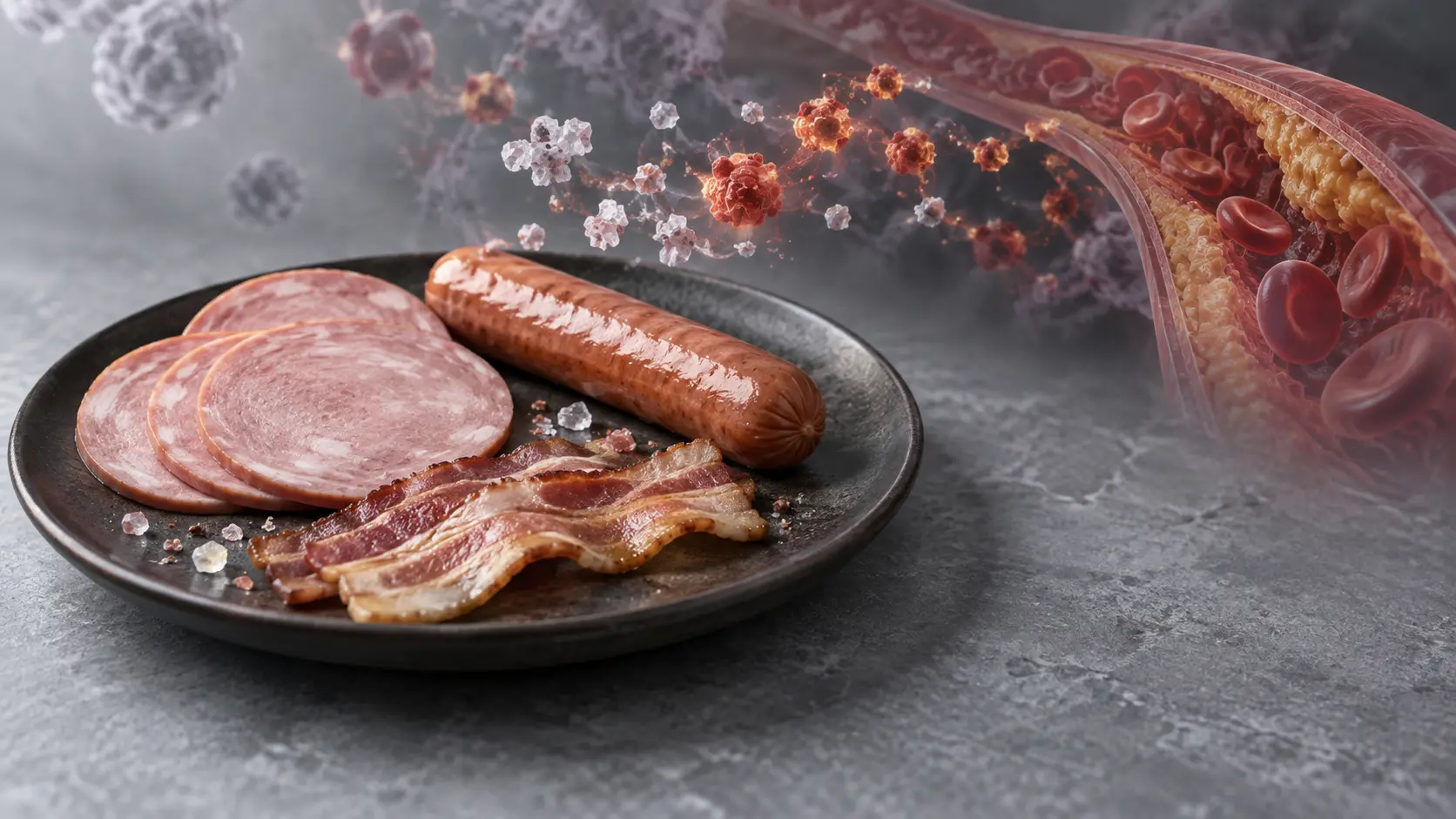
Processed meats — including bacon, sausages, hot dogs, salami, ham, and deli meats — are preserved through smoking, curing, salting, or the addition of chemical preservatives. Several components are thought to drive their health risks.
Nitrates and nitrites are used to prevent bacterial growth and maintain colour. In the body, these compounds can form nitrosamines, which are potent carcinogens. This is considered the primary mechanism linking processed meat to colorectal cancer risk.
High sodium content contributes to elevated blood pressure and endothelial dysfunction — both of which increase cardiovascular risk. In contrast to unprocessed red meat, the sodium load in processed varieties is substantially higher, even when the underlying meat is similar.
Saturated fat and haem iron are present in processed meat, as with unprocessed red meat, and may contribute to inflammation and oxidative stress. However, these factors alone do not fully explain the stronger mortality signal seen with processed meat compared to unprocessed red meat — suggesting the preservation process itself adds meaningful risk.
Advanced glycation end-products (AGEs) form during high-temperature processing and smoking. Research suggests AGEs promote chronic inflammation and may accelerate biological aging, though this mechanism is still being studied in humans.
What the Evidence Shows
Epidemiological Evidence
Large-scale cohort studies consistently show that higher processed meat intake is associated with greater all-cause mortality. For example, a major European prospective study (EPIC) involving over 400,000 participants found that those with the highest processed meat intake had meaningfully higher mortality rates than those with low intake, with cardiovascular disease and cancer accounting for most of the difference.
Importantly, this association persists after adjusting for confounding factors such as smoking, physical activity, BMI, and overall diet quality — though residual confounding can never be fully excluded in observational research. The dose-dependent nature of the relationship (more processed meat, higher risk) strengthens the case for a genuine link rather than mere correlation.
Cancer Risk
The WHO’s International Agency for Research on Cancer (IARC) classified processed meat as a Group 1 carcinogen in 2015, based on sufficient evidence of a causal link to colorectal cancer. The estimated increase in relative risk per 50g daily serving is approximately 18%, though absolute risk levels vary by baseline population risk. This classification places processed meat alongside tobacco and asbestos in terms of evidence strength — not harm magnitude — which is an important distinction.
Cardiovascular Risk
Evidence also links processed meat to cardiovascular mortality. The combination of high sodium, saturated fat, and preservatives appears to promote hypertension, arterial stiffness, and systemic inflammation — all established drivers of cardiovascular disease. In contrast, the evidence for unprocessed red meat and cardiovascular mortality is less consistent, suggesting the processing itself is a meaningful contributor. Learn more about this distinction in our article on whether red meat shortens lifespan.
How This Compares to Other Dietary Risk Factors
Within the broader landscape of diet and longevity, processed meat — alongside refined sugar and refined carbohydrates — represents one of the strongest and most consistent dietary signals for increased mortality risk. This is in contrast to foods like red meat or dairy, where evidence is more mixed, context-dependent, or dose-sensitive. For a full picture of how these dietary factors compare, see our hub on advanced diet and longevity.
Learn more in our complete guide to longevity.
Practical Implications
What This Means for Eating Patterns
The evidence does not support a zero-tolerance approach to processed meat for everyone, but it does support treating it as an occasional food rather than a dietary staple. Current evidence suggests that regular, high intake — multiple servings per week — carries the most meaningful risk, while occasional consumption appears to carry substantially lower absolute risk.
In practice, reducing processed meat intake means replacing habitual servings — daily bacon, regular deli sandwiches, frequent sausages — with less processed protein sources. Fresh poultry, fish, legumes, and eggs are all practical alternatives that do not carry the same documented risk profile. For context on how fish consumption compares, see our article on whether fish consumption increases longevity.
Reading labels is useful: products labelled as cured, smoked, or preserved with added nitrates should be treated as processed meat regardless of whether they are marketed as “natural” or “artisan.” Some manufacturers use natural nitrate sources such as celery powder, which produces equivalent nitrate levels in the final product.
Limitations and Nuance
Nutritional epidemiology has well-known limitations. Diet is difficult to measure accurately, and people who eat large amounts of processed meat often differ from those who eat little in ways that are hard to fully control for. That said, the consistency of findings across multiple countries, study designs, and analytical approaches gives the evidence meaningful weight.
It is also worth noting that the absolute risk increase from modest processed meat consumption in an otherwise healthy diet is lower than the relative risk figures sometimes suggest. Overall dietary pattern matters — a Mediterranean-style diet that includes occasional processed meat is meaningfully different in risk profile from a diet built around ultra-processed foods and low vegetable intake.
References and Resources
The following sources provide reliable, evidence-based information on processed meat and mortality risk.
Authoritative Sources on Processed Meat and Mortality Risk
-
WHO: Processed Meat and Cancer Risk
who.intCovers the IARC classification of processed meats as Group 1 carcinogens and explains the strength of evidence linking them to colorectal cancer and mortality.
-
CDC: Meat Processing and Health Risks
cdc.govProvides public health guidance on processed meat consumption and its associated health risks.
-
Academy of Nutrition and Dietetics: Processed Meat
nutrition.orgExplains the nutritional composition of processed meats and the mechanisms through which key components affect long-term health.
-
PLOS Medicine: Meat Consumption and Mortality
plos.orgA large prospective study providing epidemiological evidence on the association between processed meat intake and increased mortality risk.
-
WebMD: Processed Meats and Your Health
webmd.comAn accessible overview of the health risks associated with processed meats, including cardiovascular and cancer risk.
-
NutritionFacts.org: Processed Meats
nutritionfacts.orgCollates evidence-based summaries on processed meats and their documented health impacts.
-
JAMA Internal Medicine: Meat and Mortality
jamanetwork.comA peer-reviewed study examining the relationship between meat consumption patterns and all-cause and cause-specific mortality.

Frequently Asked Questions
Does processed meat really increase mortality risk?
Yes. Large prospective studies and systematic reviews consistently show that regular processed meat consumption is associated with higher all-cause mortality, driven primarily by increased cardiovascular disease and colorectal cancer risk. The evidence is stronger and more consistent for processed meat than for most other individual foods studied in longevity research.
What are the main health risks associated with processed meat?
The primary risks are colorectal cancer and cardiovascular disease. These are linked to the nitrates and nitrites used in preservation, high sodium content, and the formation of carcinogenic compounds during processing. Chronic inflammation is also implicated as a downstream effect of regular consumption.
Can reducing processed meat intake lower mortality risk?
Evidence suggests yes. Population studies show that lower processed meat intake is associated with reduced cardiovascular and cancer mortality. Replacing habitual processed meat servings with less processed protein sources — such as fish, legumes, or fresh poultry — is a practical step supported by the available evidence.
What practical steps can reduce the risks of processed meat?
Treat processed meat as an occasional food rather than a daily staple. Focus on whole food protein sources as defaults — fish, poultry, eggs, and legumes. When buying packaged meat products, check labels for nitrate-based preservatives, including natural sources such as celery extract, which produce equivalent compounds. Overall dietary pattern matters: occasional processed meat within an otherwise varied, plant-rich diet carries lower absolute risk than a diet dominated by ultra-processed foods.
Conclusion
Among the dietary factors studied in longevity research, processed meat has one of the most consistent and well-replicated links to increased mortality risk. The evidence — spanning large cohort studies, systematic reviews, and WHO cancer classifications — points clearly toward cardiovascular disease and colorectal cancer as the primary pathways. That does not mean occasional consumption is catastrophically harmful, but it does mean that habitual, high intake carries meaningful risk. As part of a broader approach to healthy aging, reducing processed meat in favour of less processed protein sources is one of the more evidence-supported dietary changes available.
Find out more about processed meat and mortality risk
Search for more resources and information: