How Does Kidney Function Decline With Age? (2026)
Does Kidney Function Decline With Age?
TL;DR: Yes — kidney function declines gradually and predictably with age, typically at around 1% per year after age 30. However, this normal decline is distinct from kidney disease and does not inevitably lead to serious health problems, particularly in people without major risk factors.
Kidney function does decline with age, and this is well established in the medical literature. The glomerular filtration rate (GFR) — the primary measure of how efficiently the kidneys filter waste from the blood — decreases by approximately 1 mL/min/1.73m² per year after the age of 30. This means that by age 70, most adults will have measurably lower kidney function than they did at 40, even in the absence of any kidney disease. That said, this trajectory is gradual and, for many people, clinically manageable.
Importantly, this article focuses specifically on age-related kidney decline. For broader context on how different organs age at different rates, see our guide to organ-specific aging.
What the Evidence Says
The Role of eGFR
In clinical practice, kidney function is tracked using estimated GFR (eGFR), calculated from blood creatinine levels along with age, sex, and other variables. Research consistently shows that eGFR declines across the adult lifespan, with the rate of decline accelerating somewhat in older age groups. This pattern holds across large population studies, including data from the National Kidney Foundation and longitudinal cohort research.
However, it is important to distinguish between statistical decline in a population and clinically significant impairment in an individual. Many older adults with mildly reduced eGFR — for example, between 60 and 75 — do not progress to kidney failure and live with stable, manageable kidney function for decades. Age alone does not determine outcome.
Is Decline Inevitable?
Some degree of kidney functional decline with age is normal and expected. That said, the rate and severity vary considerably between individuals. Evidence suggests that lifestyle factors, the presence or absence of chronic conditions such as hypertension and diabetes, and genetic background all influence how quickly kidney function deteriorates. In people without these risk factors, the decline may remain mild and clinically insignificant well into older age.
Structural and Functional Changes in the Aging Kidney
Structural Changes
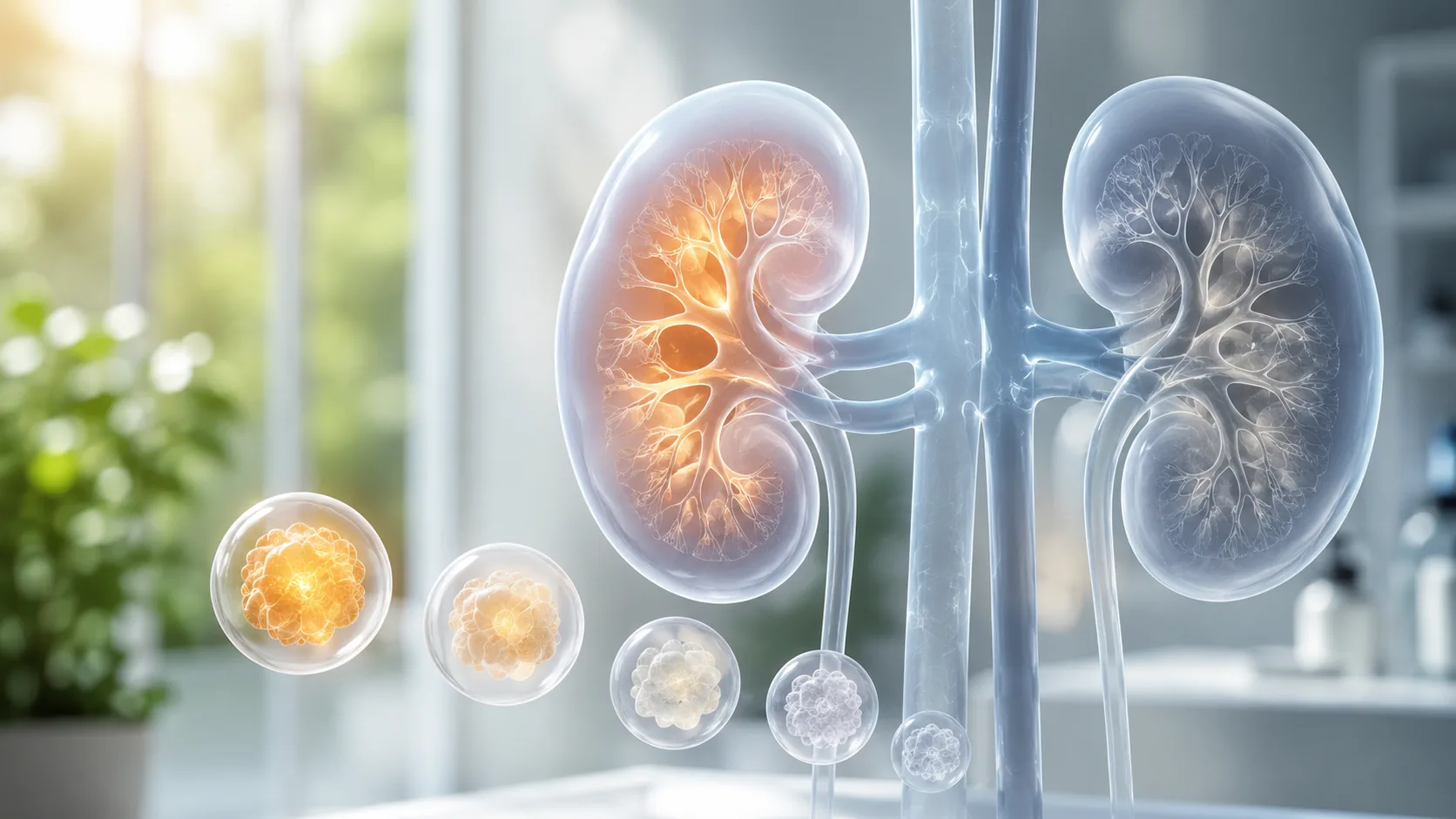
With age, the kidneys undergo measurable structural changes. Kidney mass typically decreases from around age 50 onward. The number of functioning nephrons — the microscopic filtering units — also declines, partly through natural cell loss and partly through age-related scarring of the glomeruli (glomerulosclerosis). As a result, the remaining nephrons must compensate by filtering more volume individually.
These structural shifts are gradual and often do not cause noticeable symptoms. However, they do reduce the kidney’s reserve capacity — its ability to respond to physiological stress, such as dehydration, infection, or nephrotoxic medications.
Functional Changes
Functionally, aging kidneys show reduced renal blood flow, a decreased ability to concentrate urine, and slower responses to changes in fluid and electrolyte balance. The tubular handling of substances such as potassium and sodium also becomes less efficient. In practice, this means older adults are more vulnerable to dehydration, electrolyte imbalances, and drug-related kidney injury — even when baseline eGFR appears adequate.
Chronic low-grade inflammation, which increases with age (sometimes called inflammaging), may also contribute to accelerated renal decline in some individuals. Additionally, reduced endothelial function in the renal vasculature can impair blood flow regulation over time.
Normal Decline vs. Kidney Disease
A critical distinction is often overlooked: age-related kidney decline is not the same as chronic kidney disease (CKD). CKD is defined not simply by a low eGFR, but by persistent kidney damage — evidenced by markers such as proteinuria, structural abnormalities, or eGFR below 60 mL/min/1.73m² for more than three months. By contrast, a mildly reduced eGFR in an otherwise healthy 75-year-old may reflect normal aging rather than a disease process.
This distinction matters because over-medicalising normal age-related decline can lead to unnecessary anxiety, over-investigation, and inappropriate treatment. At the same time, failing to identify true CKD — particularly in people with hypertension or diabetes — carries real risks, including cardiovascular mortality. For a closer look at how reduced eGFR connects to mortality risk, see our supporting article on whether reduced eGFR increases mortality risk.
In short, context matters. A single eGFR reading is less informative than the trajectory over time and the clinical picture as a whole.
What Can Be Done: Modifiable Factors
Lifestyle and Risk Factor Management
Several factors that accelerate kidney decline are modifiable. Hypertension is one of the most significant drivers of renal deterioration — sustained high blood pressure damages the glomerular vasculature and accelerates nephron loss beyond what aging alone would cause. Similarly, poorly controlled blood sugar in people with diabetes contributes directly to diabetic nephropathy, one of the leading causes of CKD globally.
Evidence supports the following as practically beneficial for preserving kidney function with age:
- Blood pressure control: Keeping systolic blood pressure within a healthy range reduces the rate of eGFR decline.
- Blood sugar management: In people with diabetes or prediabetes, glycaemic control is directly associated with slower renal deterioration.
- Hydration: Adequate fluid intake supports renal clearance and reduces the risk of concentration-related kidney stress.
- Avoiding nephrotoxic exposures: Regular or high-dose use of NSAIDs (such as ibuprofen), certain antibiotics, and contrast agents can cause acute kidney injury, particularly in older adults with reduced reserve.
- Smoking cessation: Smoking is independently associated with accelerated kidney function decline.
- Dietary protein and sodium: Excessive protein intake and high sodium consumption may place additional filtration burden on already-compromised kidneys. Moderate, balanced intake is generally recommended.
What Cannot Be Fully Reversed
While lifestyle changes can meaningfully slow the rate of decline, they cannot restore nephrons that have already been lost or reverse established glomerulosclerosis. Some functional improvement may occur when risk factors such as hypertension or inflammation are well controlled, but full restoration of age-related kidney decline is not a realistic clinical outcome based on current evidence. Emerging research into regenerative medicine is ongoing, but these approaches remain experimental.
Regular kidney function monitoring — particularly eGFR and urine protein levels — remains the most practical way to track kidney health over time and intervene early when decline accelerates beyond the expected age-related rate. Learn more in our complete guide to longevity.
References and Resources
Authoritative Sources on Kidney Function and Aging
-
National Kidney Foundation
Kidney.orgComprehensive information on kidney health, eGFR interpretation, and age-related changes in renal function.
-
CDC — Chronic Kidney Disease
CDC.govData and public health guidance on CKD risk factors, prevalence by age, and prevention strategies.
-
Agency for Healthcare Research and Quality
AHRQ.govEvidence-based research and clinical recommendations on aging and kidney function.
-
National Institutes of Health
NIH.govPeer-reviewed research on renal physiology, age-related structural changes, and emerging therapeutic approaches.
-
New England Journal of Medicine
NEJM.orgHigh-quality clinical and mechanistic research on renal aging, GFR decline, and kidney disease progression.
-
American Society of Nephrology
ASN-online.orgExpert clinical insights and research on kidney disease, age-related decline, and nephron physiology.

Frequently Asked Questions
Does age-related kidney decline always lead to kidney disease?
No. A gradual reduction in eGFR is a normal part of aging and does not automatically indicate kidney disease. CKD is defined by persistent damage — such as proteinuria or eGFR below 60 for more than three months — not by age-related decline alone. Many older adults maintain stable, sufficient kidney function throughout their lives, particularly in the absence of hypertension, diabetes, or other risk factors.
What are the signs that kidney function is declining beyond normal aging?
Early renal decline is typically asymptomatic, which is why routine blood and urine testing is important. More significant impairment may present as fatigue, fluid retention, changes in urination frequency or colour, or difficulty concentrating. These symptoms warrant medical evaluation rather than self-management. Anyone over 50, or with established risk factors, should have eGFR and urine protein assessed regularly.
Can lifestyle changes slow age-related kidney decline?
Yes, meaningfully so — particularly when modifiable risk factors are present. Controlling blood pressure and blood sugar, staying well hydrated, avoiding nephrotoxic drugs, and not smoking are all supported by evidence as protective. These measures do not reverse existing structural loss, but they can reduce the rate of further decline.
Should I be concerned if my eGFR is slightly low for my age?
Not necessarily. A mildly reduced eGFR in an older adult — particularly above 60 mL/min/1.73m² — may fall within the expected range for age. What matters more is the trend over time and whether other markers such as proteinuria are present. A single reading should be interpreted in clinical context, ideally with a healthcare professional who can assess the full picture.
How does kidney aging relate to overall longevity and healthspan?
Kidney function is a meaningful marker of systemic health. Significantly reduced eGFR is associated with increased cardiovascular risk and all-cause mortality, though the relationship is most pronounced in the context of true CKD rather than mild age-related decline. Maintaining kidney health through risk factor management contributes to broader healthspan and reduces downstream complications in other organ systems.
Conclusion
Kidney function does decline with age — this is a well-established and predictable biological process, driven by structural nephron loss, reduced renal blood flow, and cumulative physiological change. However, the extent and clinical significance of that decline varies considerably between individuals. Normal, gradual age-related decline is not the same as chronic kidney disease, and conflating the two can cause unnecessary concern or lead to over-medicalisation of a natural process.
The most important practical steps are monitoring eGFR and urine protein over time, managing blood pressure and blood sugar, and avoiding exposures that unnecessarily burden the kidneys. These measures do not reverse aging at the renal level, but evidence supports their role in slowing further deterioration. In the context of longevity, preserving kidney function is one part of a broader approach to organ health — not an isolated goal, but an interconnected one.
Find out more information about kidney function and aging
Search for more resources and information: