
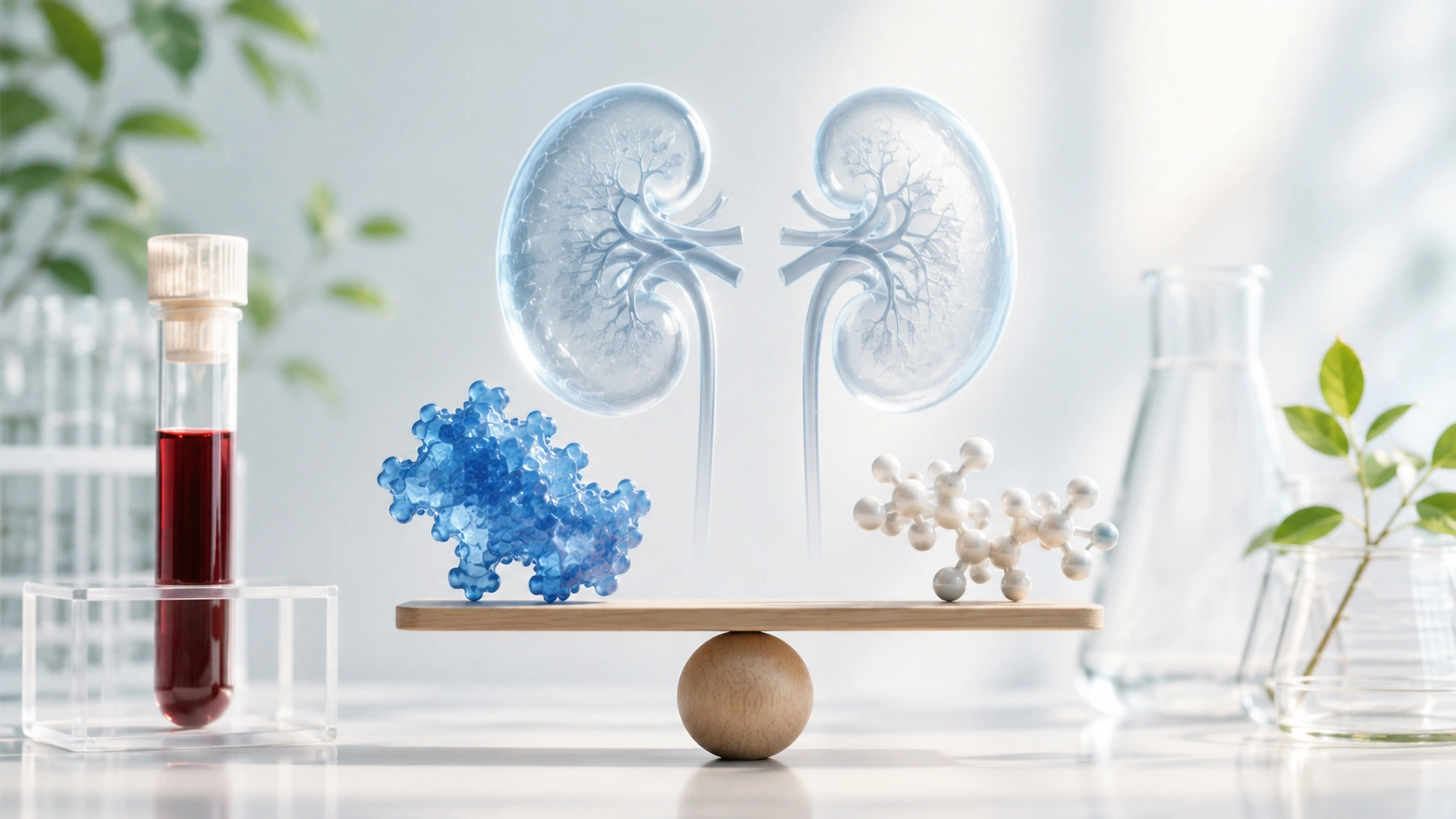
Does Cystatin C Predict Longevity Better Than Creatinine?
Does Cystatin C Predict Longevity Better Than Creatinine?
TL;DR: Cystatin C is generally a more reliable marker of kidney function than creatinine, particularly in older adults and those with low muscle mass. Research suggests it more consistently predicts mortality risk, making it a useful addition to a longevity blood panel — though it works best alongside other markers rather than as a standalone test.
Evidence suggests that cystatin C predicts longevity outcomes more accurately than creatinine in most populations. Unlike creatinine, cystatin C is not meaningfully affected by muscle mass, diet, or physical activity — factors that can distort creatinine readings and lead to missed kidney function decline. For longevity assessment, this distinction matters, particularly as people age and muscle mass naturally decreases.
What Is Cystatin C and How Does It Differ from Creatinine?
Cystatin C: The Basics
Cystatin C is a small protein produced at a relatively constant rate by virtually all nucleated cells in the body. It is freely filtered by the kidneys and not meaningfully reabsorbed, which makes it a reliable proxy for glomerular filtration rate (GFR) — the kidneys’ filtering capacity. Because production is consistent across different body types, cystatin C levels reflect kidney function rather than body composition.
Learn more about how this marker works in our article on what cystatin C is and why it matters.
How Creatinine Differs
Creatinine is a waste product of muscle metabolism, also filtered by the kidneys. However, because it is derived from muscle tissue, creatinine levels are directly influenced by muscle mass, protein intake, and hydration. As a result, someone with low muscle mass — such as an older adult, a sedentary individual, or someone who has lost weight — may have a creatinine level that appears normal even when their kidney function is meaningfully reduced.
This is a well-recognised limitation. In contrast, cystatin C is largely independent of these variables, which gives it an advantage in populations where muscle mass is not a reliable constant. That said, cystatin C can be influenced by thyroid status, corticosteroid use, and systemic inflammation — factors worth bearing in mind when interpreting results.
Why Kidney Function Matters for Longevity
Kidney function is not simply a measure of renal health in isolation. The kidneys regulate blood pressure, fluid balance, waste clearance, and the activation of key hormones. Declining kidney function — even at subclinical levels — is associated with increased cardiovascular risk, accelerated inflammation, and higher all-cause mortality.
For longevity purposes, this means that accurately assessing kidney function is more than a clinical formality. Subtle, early declines in GFR that go undetected by creatinine alone may already be contributing to broader systemic risk. This is precisely where cystatin C can add value beyond a standard annual blood test. For broader context on why kidney-related markers belong on a longevity panel, see our hub on the most complete longevity blood panel.
What the Evidence Says About Cystatin C and Mortality Risk
Association with All-Cause Mortality
Multiple large longitudinal studies have found that elevated cystatin C is associated with increased risk of all-cause mortality, cardiovascular events, and functional decline — even in individuals whose creatinine levels appear normal. Importantly, this association holds after adjusting for traditional risk factors, suggesting that cystatin C captures risk information that creatinine does not.
Research also indicates that cystatin C-based eGFR (estimated GFR) equations reclassify a meaningful proportion of individuals into higher or lower risk categories compared to creatinine-based equations alone. In older adults particularly, creatinine-based equations tend to overestimate kidney function, which can result in missed risk stratification.
Combined Equations May Offer the Best Accuracy
Current clinical guidance, including recommendations from kidney function research consortia, suggests that equations combining both cystatin C and creatinine (such as the CKD-EPI creatinine-cystatin C equation) provide the most accurate GFR estimates. In practice, this means that cystatin C is most useful not as a replacement for creatinine, but as an additional layer of information — particularly when creatinine alone seems inconsistent with clinical presentation.
For longevity tracking, however, measuring cystatin C at least once — especially from middle age onwards — provides a more complete picture of kidney health and risk than creatinine alone.
Practical Implications: When Does Cystatin C Add Value?
Cystatin C is most clinically useful in specific contexts. These include older adults where muscle mass may be low, individuals whose creatinine falls in a borderline range, people with unexplained fatigue or cardiovascular risk factors, and anyone building a more thorough longevity blood panel.
In practice, a normal creatinine result does not rule out early kidney function decline. Adding cystatin C can either confirm that kidney function is genuinely preserved or flag a discrepancy that warrants closer attention. This is particularly relevant because many interventions that support longevity — such as optimising blood pressure, reducing inflammation, and improving metabolic health — also support kidney function. Knowing the true baseline helps track whether those interventions are having an effect.
For those building a structured testing strategy, learn more in our complete guide to longevity.
Limitations and Nuance
Cystatin C is not a perfect biomarker. As noted, it can be elevated by hyperthyroidism, high-dose corticosteroid use, and active inflammation — independent of kidney function. This means that an elevated cystatin C result should be interpreted in context rather than treated as a definitive marker of kidney decline.
It is also worth noting that cystatin C reflects kidney function specifically. While kidney function is closely linked to cardiovascular and metabolic health, cystatin C does not directly measure inflammation, cardiovascular risk, or biological ageing in the way that markers like hs-CRP, ApoB, or fasting insulin do. It is one piece of a broader panel, not a comprehensive ageing biomarker on its own.
Furthermore, most people do not need to test cystatin C repeatedly at high frequency. For most individuals, measuring it once in midlife, and again if creatinine or clinical presentation raises questions, is a reasonable approach. Chasing marginal fluctuations in cystatin C without a clear clinical reason does not improve health outcomes.
References and Resources
Sources and Further Reading
-
NIH: Cystatin C as a Biomarker of Aging
nih.govOverview of cystatin C’s role as an ageing biomarker, including NIH-funded research on its predictive value for mortality and functional decline.
-
NEJM: Comparative Analysis of Kidney Biomarkers
nejm.orgA landmark study comparing cystatin C and creatinine as predictors of kidney disease progression and mortality outcomes.
-
ScienceDirect: Biomarkers in Aging
sciencedirect.comA review of ageing biomarkers including cystatin C, with analysis of their predictive value for longevity-related outcomes.
-
Circulation Research: Kidney Function and Cardiovascular Aging
ahajournals.orgExamines the relationship between kidney function markers, cardiovascular ageing, and long-term health outcomes.
-
Frontiers in Medicine: Aging Biomarkers
frontiersin.orgA review covering the role of biomarkers including cystatin C in predicting ageing trajectories and longevity-related risk.
-
World Health Organization: Ageing and Health
who.intWHO context on healthy ageing, the importance of early risk detection, and the role of biomarkers in extending healthspan.

-
NIH PubMed Central: Kidney Biomarkers and Aging
ncbi.nlm.nih.govResearch on cystatin C and related kidney biomarkers, their limitations, and their utility in predicting ageing-related outcomes.
Frequently Asked Questions
Does cystatin C predict longevity better than creatinine?
Evidence suggests yes, in most cases. Cystatin C is less affected by muscle mass and diet, which makes it a more consistent marker of true kidney function — particularly in older adults. Research consistently links elevated cystatin C with increased mortality risk, even when creatinine appears normal. That said, combining both markers typically provides the most accurate kidney function estimate.
Why is cystatin C considered a better biomarker for ageing?
Cystatin C is produced at a near-constant rate regardless of body composition, which makes it a more stable proxy for kidney filtration capacity. Because declining kidney function is closely tied to cardiovascular risk, inflammation, and overall mortality, a more accurate measure of that function offers better insight into biological ageing. Creatinine, by contrast, can normalise artificially in people with low muscle mass, masking early decline.
Can I rely solely on creatinine for longevity-related testing?
Creatinine alone has well-known limitations, particularly in older adults and those with lower muscle mass. It can overestimate kidney function in these groups, which may leave early decline undetected. Adding cystatin C provides a more complete picture. For a longevity panel, measuring both — or using a combined GFR equation — is the more informative approach.
How can I use cystatin C practically for health monitoring?
For most people, measuring cystatin C once in midlife establishes a useful baseline. It is worth retesting if creatinine results seem inconsistent with overall health, if cardiovascular risk factors are present, or if a thorough longevity panel is being built. Lifestyle factors that support kidney health — including blood pressure control, metabolic health, regular exercise, and avoiding nephrotoxic substances — remain the most actionable response to any concerning result.
Conclusion
Overall, cystatin C is a more reliable predictor of kidney function and longevity-related risk than creatinine alone — particularly in older adults, those with lower muscle mass, and anyone whose creatinine sits in a borderline range. Research consistently shows that elevated cystatin C associates with increased mortality risk independent of traditional risk factors, and that creatinine-based estimates can meaningfully overestimate kidney function in certain populations.
That said, cystatin C is most useful as part of a broader testing strategy rather than as a standalone ageing biomarker. It reflects kidney function specifically, and interpreting it alongside creatinine, cardiovascular markers, and metabolic indicators gives a far more complete picture. For most people, measuring it at least once from midlife onwards is a reasonable and informative step — not something that needs to be tracked obsessively, but a useful data point that standard testing often misses.
Find out more about cystatin C and longevity prediction
Search for more resources and information: